
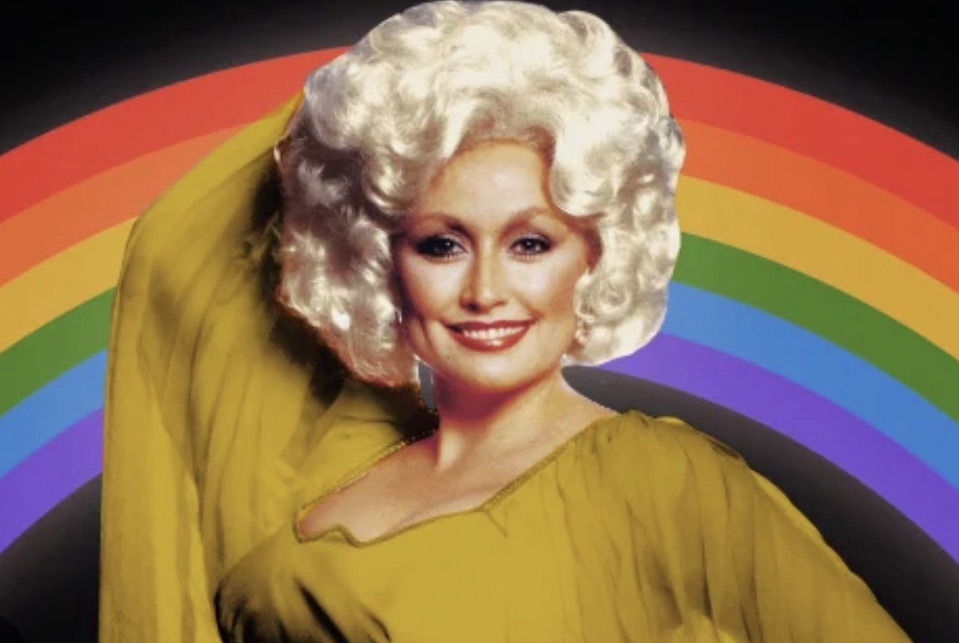
Here’s a fun fact you may not know about me: I freaking adore country music. When I was really little, it was my favorite genre. And why wouldn’t it be? I grew up in a family of crazy hillbillies who migrated to Michigan and brought their rich Appalachian culture with them. Country was nearly ubiquitous in every facet of my life for the first chunk of it. Shania Twain was my idol as a toddler. I have fond memories of listening to Brooks and Dunn in my dad’s old truck and going through my grandma’s dusty Alan Jackson cassettes. And of course, we had Queen Dolly.
I never dove as deep into Dolly Parton’s discography as I should have, but a part of me has always been fascinated by her. I recall going to Dixie Stampede when my family travelled to Tennessee on vacation. I remember my first amusement park experience was Dollywood. My parents kicked themselves for not getting tickets for a day later, when Miss Dolly herself would make an appearance at the park. It’s sad that I came so close to crossing paths with her as a child, and yet I missed it by a hair.
Now, I’ll never get that opportunity again. As I’m certain you’ve heard by now, Dolly Parton passed away a few days back at the age of 80. The closest thing I’ve seen to monoculture in a post-social media world has been the enormous outpouring of love for her and what she has come to represent. I have even seen multiple pushes to make her a literal saint. To say Dolly was beloved would be the understatement of the century. She was more than just beloved. She was America’s grandma.
I’ve learned so much more about the life of this incredible woman in the past few days, and it has been inspiring me to seek out little ways to honor her memory. Now that she is no longer with us, we all need to carry on the work she began. These are just a few lessons I’ve gleaned from Dolly’s illustrious legacy.
1. Reading is knowledge, and knowledge is power.
We as a nation are experiencing a literacy crisis. There are more illiterate adults today than there were in 1870. This is a significant decline since the 1970s, when less than one percent of the population was illiterate. I can see correlations between this slow drop in literacy and the increasing animosity in our society. Reading allows you to understand different perspectives. Reading encourages critical thinking. Reading is how people learn new things. Is it a coincidence that as we’ve decentered reading as an American pastime, we’ve also seen an increase in division and conflict?
Dolly saw a need, and she had the power to do something. So she started the Imagination Library, a service that sends books to kids for free. The decision was prompted by her own father’s inability to read. In a statement on the website, she said:
“When I was growing up in the hills of East Tennessee, I knew my dreams would come true. I know there are children in your community with their own dreams. They dream of becoming a doctor or an inventor or a minister. Who knows, maybe there is a little girl whose dream is to be a writer and singer…The seeds of these dreams are often found in books and the seeds you help plant in your community can grow across the world.”
She always had a heart for kids who grew up in similar situations to her. Dolly didn’t grow up in a gilded castle. She was once a little girl in a destitute part of Appalachia — much like my own grandmother was, many years ago. She may have gone on to become a household name, but her heart was always with families like mine. Which leads me to the next lesson Dolly taught me…
2. Stand up for the working class.
When Dolly wrote “9 to 5,” it was a statement. Like I mentioned before, she was not born into a wealthy family by any means. The nepo babies taking over the charts today will never know the struggle she had to endure to get to where she is. The woman fought tooth and acrylic nail for the respect she deserved. And all the while, she never forgot where she came from. In a recent conversation I had on Reddit, another commenter lamented the fact that there were no femme Springsteens championing the working class. Enter Dolly.
Like my own daddy, Dolly was a supporter of unions, being part of the American Federation of Musicians Local 257 and making it a point to get her band the wages they deserved. She supported migrant workers the rest of the country turned their nose at, covering Woody Guthrie’s “Deportee (Plane Wreck at Los Gatos),” dedicated to the memory of 28 Mexican farmhands whose deaths were largely ignored. She even stood up for ladies who wound up in the world’s oldest profession, with the understanding that many sex workers were simply sweet girls with broken dreams and no other options. In fact, this leads to my next point that…
3. You can dress scandalously and still be a good person.
Dolly was the poster girl for not judging a book by its cover. On the surface, she had the outward appearance of the traditional “bimbo”: blonde, thin waist, big boobs, lots of makeup, and little clothing. This was not an accident. Dolly herself had said that she styled her own signature look around “the town tramp” whom everyone looked down upon. But young Dolly saw the beauty in her and wanted to be her nonetheless. That was one of her most underrated gifts. She realized beauty in places — and in people — you wouldn’t think to look.
I think a lot about the ways women are judged for owning their sexualities and bodies. I’ve experienced it myself. I recognize that my own signature look is somewhere between a drag queen, a Bratz doll, and probably the town tramp as well. But as Dolly showed us, wearing skimpy costumes and lots of sparkles doesn’t make you less of a person. This is a woman who posed for Playboy of all publications. She didn’t practice modesty the way American Christianity pushes. She had the understanding that modesty is a mindset, not a certain look. I’d guarantee Dolly is closer to the heart of God than any of these tradwife influencers with their prairie dresses that could double as a tent, and all while wearing a sequined unitard.
4. You can be a Christian and not a bigot.
Speaking of American Christianity, it’s no secret that many folks who claim the title of “Christian” in this country are not the ambassadors we want for the faith. “Christian values” has become shorthand for “defending the (relatively new) concept of the nuclear family to the detriment of anyone who doesn’t fit that box.” If you’re a man, you gotta be a big strong dude and marry a woman and make her submit to you. If you’re a woman, better give up all your dreams to a man who doesn’t know how to do his own laundry and pop out his babies for the Lord. That’s the dream we’ve been sold. But Dolly taught us there is a better way.
Dolly was a proper Christian, if a bit of an outlaw Christian. She understood the true tenets of the faith. Like me, she cut her teeth playing in churches and built up a strong foundation for her spiritual beliefs. In her prayer life, she regularly asked God “How can you use me?” and “What can I do today?” I can imagine her saying as Isaiah 6:8 says: “Here am I. Send me!” She knew she had a mission here on this planet to be the hands and feet of Jesus in a very tangible way. Unlike many others who have co-opted the name of Christ, Dolly refused to engage with the widespread bigotry that permeates the religion as it stands. She spent her life proving to the world that being a strong ally to the queer community and being a steadfast Christian is not an oxymoron. In fact, standing up for the oppressed and downtrodden is exactly what we’re supposed to do. She was a true example of the faith. In a world of Donald Christians, be a Dolly Christian.
5. You don’t have to be a literal mother to be a “Mom.”
This one hit home for me as someone who desperately wants to be a mother but is afraid that ship has sailed. Dolly also longed for motherhood, but for a variety of health reasons, her dreams were never able to come to fruition either. But she realized God had another plan for her, a plan she embraced wholeheartedly. She wasn’t supposed to be the mother of a person. She was to be the mother of a movement. She started viewing herself as a “Fairy Godmother” or “Mother Goose” of sorts, with her book program introducing her to an entirely new crop of kids. In a way, Dolly became America’s mother and grandmother.
Dolly proved that you don’t have to squeeze out a biological child to have an impact on the next generation. Going back to the spiritual side of things, I often think about how our society’s current understanding of the Bible presses people to “go forth and multiply.” There are entire “quiverfull” sects that emphasize reproducing as much as humanly possible to “raise up more soldiers for the Lord.” It’s easy to forget that the Gospel has never been about passing down your own bloodline. It’s about the blood of Christ and passing down His legacy of love. Dolly demonstrated this in action. Through her work on Earth, she has done more to further the Kingdom of God than any of those quiverfull weirdos.
6. Stay humble and remember your roots.
Dolly was a superstar. Dolly was an icon. But most importantly, Dolly was a little old Appalachian lady just like my own grandmother. She saw the world and everything it had to offer, but she never lost sight of where she came from. At the end of the day, her heart remained in those storied mountains, with the honest, hard-working folks she’d grown up around. She had a soft spot for the land that gave her life, writing these words in her 1972 song “My Tennessee Mountain Home”:
“Sittin’ on the front porch on a summer afternoon
In a straight back chair on two legs leaned against the wall
As I watch the kids a-playin’ with their June bugs on a string
And chase the glowin’ fireflies when evenin’ shadows fall
In my Tennessee mountain home
Life is as peaceful as a baby’s sigh
In my Tennessee mountain home
Crickets are singing in the fields near by…”
In the 90s, Dolly promised to give $500 to every kid who went on to graduate from high school in her home county, essentially causing the drop-out rate to plummet. She has donated a good chunk of her fortune to disaster relief and other initiatives in East Tennessee. Through it all, she never forgot where she came from. I’ll leave you with this quote from The Christian Post in 2019 that I feel embodies her life and legacy:
“Every day I pray for God to lead me and to take out all the wrong things, wrong people in my life, and bring all the right things, right people, and to let me glorify Him and uplift mankind, to do something in this world to make it a little better than it was. And let me be a light and a vessel to be used.”
That’s what it’s all about, y’all. In a world of insincerity that rewards braggarts and egotism, let us all be more like Dolly. Bring a little music and sparkle to this dark world, and leave it brighter than you found it. Together, we can continue the work she started.

