The Sincerest Form of Flattery (And Why Taylor — Or Anyone Else — Shouldn’t Have to Apologize For “Stealing” Songs)

Ah, Taylor. I don’t even have to write her last name and you already know who I’m referring to.
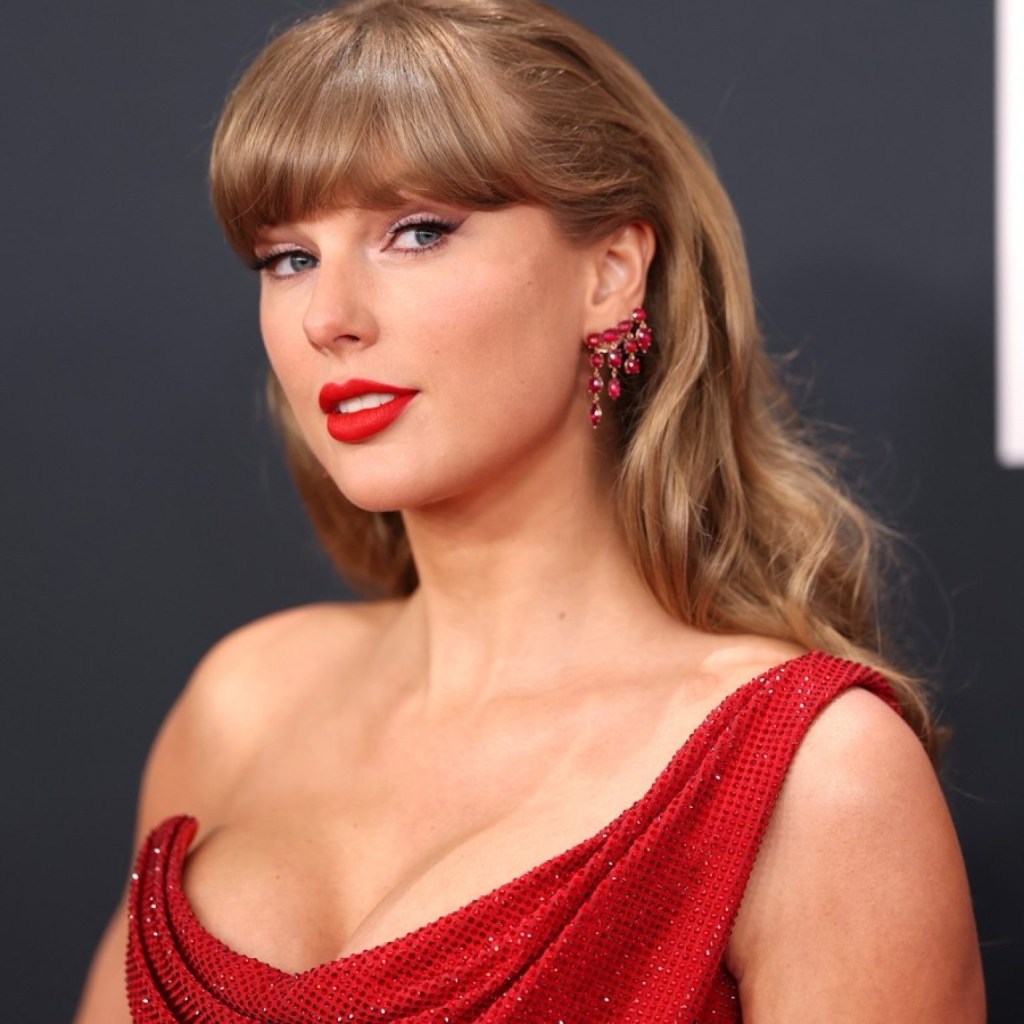
It’s me, hi!

Unless you’re just getting back from a year-long sabbatical during which you traversed the steppes of Uzbekistan with nothing but a backpack and no phone, you probably well aware that Ms. Swift just dropped a new album. And it’s…just okay. It’s nothing to write home about, especially when compared to her masterful previous works, and the lyricism seems to have regressed significantly. I’ll probably write a full review of the album in the next week or so, but I wanted to touch on one of the biggest talking points that’s come up during this album cycle. And it’s probably the talking point that’s been driving me the most bananapants.

Which is just how hilariously clueless the general public is when it comes to music.

Okay, that might have sounded a bit mean coming from a bitch with a music degree and decades of experience, so let me reword it a little nicer — the vast majority of the population has no idea how music theory actually works, especially in the context of copyright law. Now I’m not a lawyer, but I do know a little bit about what can be copyrighted and what can’t. Still, I want to focus more on the music side of things rather than the law side, because that’s the more fun side, right?

I guess you could count this thing as a percussion instrument.

Anyways, let’s start here — you got these songs. There’s the questionable Charli XCX diss track, “Actually Romantic.” Among the many complaints about the song, particularly that it’s disproportionately mean-spirited, is the observation that it sounds suspiciously like the 1988 Pixies single “Where Is My Mind?” Then you have “Wood,” Tay’s tacky ode to her man’s…manhood, which people have said sounds suspiciously like the legendary Jackson 5 hit “I Want You Back.” And the song I consider lyrically the strongest of this batch, her title track collab with my current celebrity girl-crush, Sabrina Carpenter, shares a similar feeling to “Cool” by the Jonas Brothers, who were famously her associates early in her career. So what the fuck, Taylor? Are we blatantly ripping off other artists now?

And here’s the part where I get to say “Well, ACKSHUALLY” and defend Taylor’s compositional choices (even if some of the lyrical choices are much harder to defend — looking at you again, “Wood”).
Thank you SO MUCH for making me picture Travis Kelce’s rock hard redwood tree…

In the Western music tradition, you’ve got 12 notes: A through G, plus the sharps/flats in between. It’s important to note that out of these 12 notes, only a handful sound good together. Those notes that sound good together form the “key” of any given song. The key is essentially the artist’s palette of colors. Those are the notes you can put in your song that will actually sound like they fit in the song. Anything outside of the key will sound off and even unsettling at times. That being said, you can use notes that don’t fit into the key, but it takes a certain degree of finesse and theory knowledge to pull off nicely. But for the most part, you’ve got maybe seven notes to work with, which, ya know, ain’t a lot.

Let’s get to chord progressions. What is a chord progression? Well, have you ever listened to “Poker Face” by Lady Gaga and Luis Fonsi’s “Despacito” back to back? Even though the genres of the songs are completely different, the “vibe” is still eerily similar. And that is because they share the same chord progression. There are many, many more examples. “Africa” by Toto. “One of Us” by Joan Osborne. “Peace of Mind” by Boston. “Fuckin’ Problems” by A$AP Rocky. “Alone” by my freaking favorite band of all time, Heart. And that’s just one famous chord progression. The progression the Beatles used in “Twist and Shout” was practically ubiquitous in the 50s and 60s, and the blues as a genre likely wouldn’t even exist without the 12-bar progression we know and love. And — this is important — you cannot copyright a chord progression. If I wanted to write a song that uses the exact same chord progression as Taylor’s “Love Story,” I could — and I have. Heck, she has even plagiarized herself in this regard. Go listen to “Shake It Off” and “Eldest Daughter” one after the other and tell me the latter doesn’t sound like a more somber, slowed down version of the first. That’s because they use the same three-chord progression.

Did Tay lift the chord progressions for her new songs from preexisting songs? There’s a chance, but even if she did, you have to remember that musicians have been gleaning ideas from each other for time immemorial. Everyone is influenced by someone. But there’s also a decent chance she just sat down at her piano or with a guitar and those are the chords that naturally came out. Because, like I mentioned earlier, they just sound good together. Our ears are conditioned since birth to listen for patterns in music, and you’re so used to hearing a V chord resolve into a I chord (that’s historically the most common way to end a musical phrase — the authentic cadence). So when you go to write a song, that’s what you naturally gravitate toward.

There is a great deal of discourse around the supposed lack of originality on this album, but I don’t think that’s a fair critique. I think there are plenty of valid critiques when it comes to this album, but I don’t think this is one of them. You could argue that Taylor opened herself up to more scrutiny in this area when she went after Olivia Rodrigo for rights on a song that only marginally sounded like hers (and like, only if you squint). At the same time, I don’t like any criticism of “copying” in songwriting unless it’s a particularly egregious example. Music, at the end of the day, is a social art, and musicians are going to keep borrowing from each other like they always have. As one of my favorite writers, Austin Kleon, says, it’s okay to “steal like an artist.” I’m allowed to have influences. You’re allowed to have influences.

And so is Taylor.
How Ephemeral Love Becomes Eternal Through Music

Brace yourselves, kids. In this post, I mention both Heart and Taylor Swift.

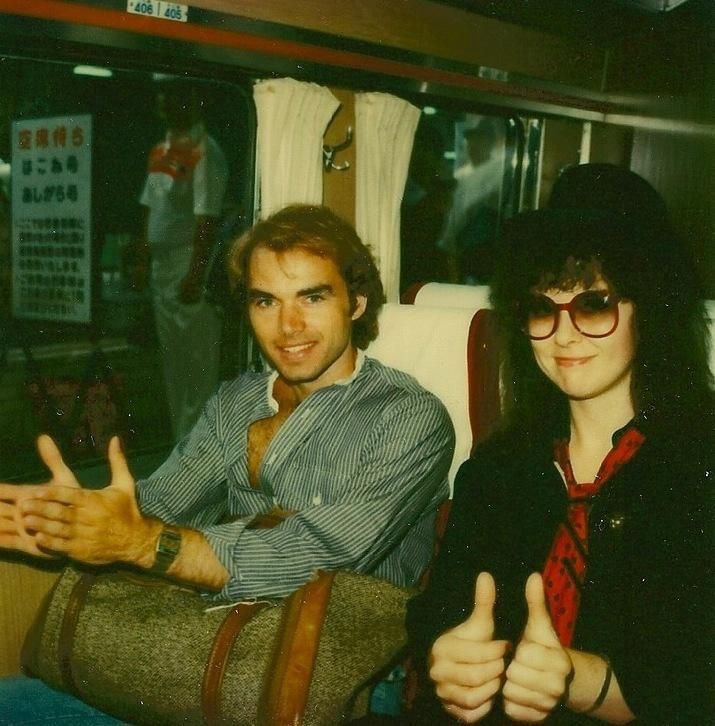
A few days ago, Heart’s original manager, Michael Fisher, passed away. Actually, calling him just their manager is kind of an understatement. In the autobiography of Heart frontwomen Ann and Nancy Wilson, Kicking & Dreaming, Ann tells the story of how Michael was her first love. Their whirlwind relationship inspired one of the band’s earliest and most iconic songs, “Magic Man.”

Why do I mention this? Obviously, Ann and Michael didn’t work out. Michael ended up marrying someone else and having like eleven freakin’ kids, and Ann went on to become a rock star. But their stories are forever intertwined because of that one song. And that’s what this post is about, because when you write a song for someone — or create any art in their honor — you’re preserving a piece of that relationship forever.

I’m a lifelong songwriter. I’m also fascinated by interpersonal dynamics. If you took every song I’ve ever written throughout my life, they would tell countless stories of people who have come and gone and somehow left a mark on me. The songs almost act as containers for the emotions left behind by those old relationships. Each song is a museum of memories. That’s why I have this theory when it comes to songwriting. Well, maybe it’s more of a maxim than a theory. And the maxim is this: If you get even one beautiful creation out of a relationship, it was not a waste of time.

People enter into relationships usually expecting — or at least hoping — to spend forever with someone. The point of dating is to find “your person” (or people, if you’re polyamorous like myself). So when relationships go south, it’s easy to write off the entire experience as meaningless. That’s where art comes in, though. With the magic of creativity, even the shortest-lived tryst can be fuel for a song or a film or a poem or painting.

Taylor Swift is a songwriter I admire deeply, and she’s a great example of this maxim in action. People have given her so much shit throughout the years for writing about her relationships, but honestly, that’s one of the things I like about her writing style. Not because I’m one of those parasocial weirdos who obsess over her dating history, but because that’s how I write songs too. I write about people. She has had many exes, as have I, but I feel like that’s what makes us better at writing. We have these lived experiences we can churn into music, and nothing can take that away from us. Like, she’s not with Taylor Lautner anymore and she hasn’t been with him for over a decade. But “Back to December” is still a beautiful song all these years later, and a song that millions of people still listen to and relate to.

I think of my own songwriting similarly. I think back to Jacob, whom I had a short-lived fling with my freshman year of college that led to the writing of “Smiles & Anchors” and “Tsvi.” I think about Dylan, my high school crush, who inspired “Off the Deep End” and the unreleased track “Outta My System” off my upcoming album Lore. There’s TJ, the muse behind “Song of the Sea,” and Phil, who never reciprocated my feelings but nonetheless influenced the writing of “Oceanography.” There are even songs I’ve squeezed out my non-romantic relationships and the ones that really went south, like the falling out with a former bandmate that led to the writing of “Ladies Don’t Start Fights (But They Can Finish Them).” I can find closure for relationships I wasn’t ready to leave just yet, and peace in relationships I’m happy are over, all because I’ve been able to transmute the pain into something I’m proud of.

I know I write about songwriting pretty frequently, but it is something I’m deeply passionate about. It’s what has gotten me through many breakups and heartaches and unrequited loves. But none of those situations were in vain, all because I could make something beautiful out of them. Relationships — romantic and otherwise — are the backbone of songwriting. We write about human beings and the way they relate to each other. Maybe those relationships don’t last forever, and sometimes, they shouldn’t last forever. Michael Fisher may have been absolutely miserable had he ended up with Ann Wilson, and vice versa, but the love they shared briefly inspired music that people will treasure for generations to come. And to me, that’s the beauty of songwriting.

If you enjoyed the writing in this post and elsewhere on the site, please consider donating to Jessa’s tuition fund! Any help is appreciated!

CashApp: $TheJessaJoyce

Venmo: @TheJessaJoyce

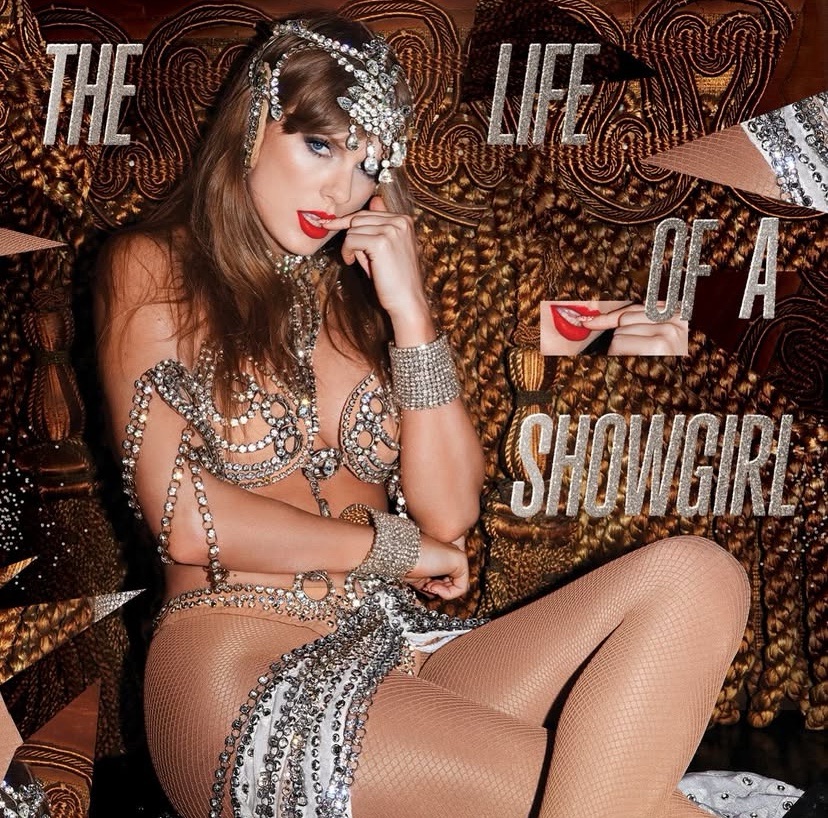
The Life of a Showgirl: Why the Arts Matter in a World on Fire

So Taylor Swift announced a new album.

And I am announcing that I am very gay for this woman.

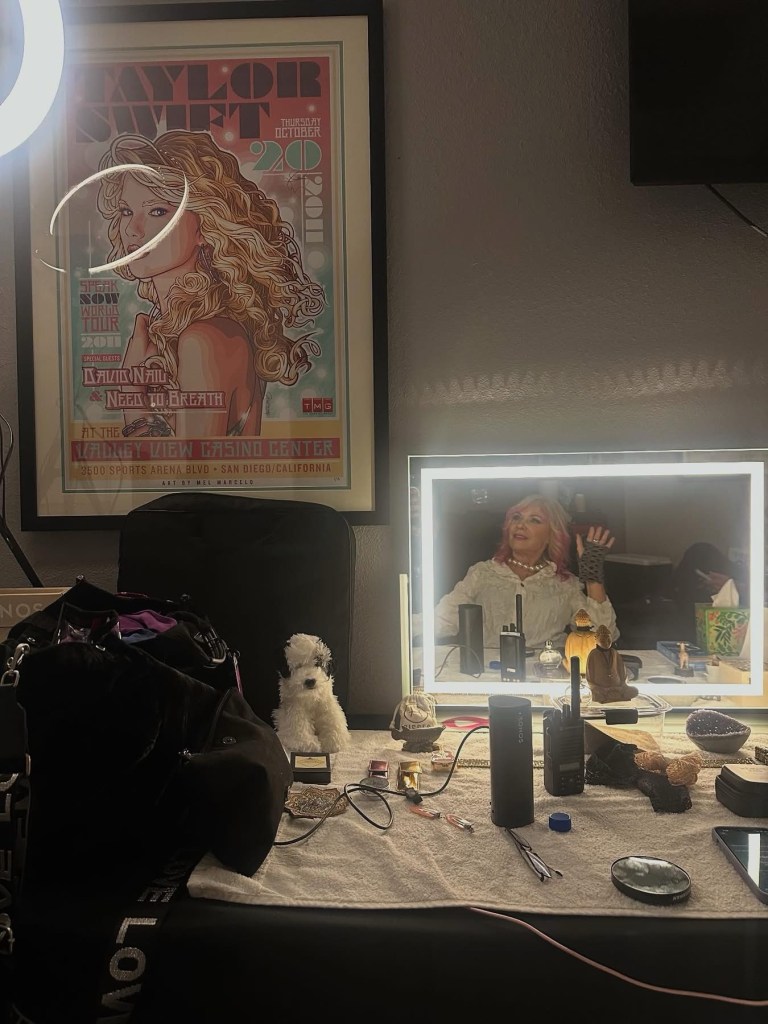
The world came to a crashing halt, all because the biggest pop star on the planet teased some new music. Fans, celebrities, corporations, and motherfucking Elmo paid homage to Swift in their own ways. Even one of my personal heroes, Nancy Wilson of Heart, got in on the Tay love, posting this picture with the caption “life of a showgirl.”

To be clear, Nancy is the woman in the mirror, not the tiny adorable pupper.

With the announcement of the new album casting an orange glow over the world, it’s easy to miss the fires that have been raging the entire time. Trump’s Big Bonkers Bill is gutting healthcare for millions of Americans who rely on it. Public radio and television, one of the last bastions of true journalism and free speech, is also being gutted. And you have that quadruple-divorced fucko who swears she knows so much about the “sanctity of marriage” trying to take away my right to have a wife and family, so I mean, it’s fucking personal now. Then you throw on everything happening in Ukraine and Palestine and it’s fucking exhausting. The world’s on fire. Innocent folks are dying, and everyone’s freaking out over a Taylor Swift album?!

But — and hear me out, here — that might not be a bad thing.

I’ve written on this site about the concept of “glimmers,” which are functionally the opposite of triggers. While a trigger is an event that causes you to feel uncomfortable or afraid, a glimmer is an event that brings intense joy. They’re the tiny moments that make life worth living. A lot of glimmers come through art. Think about the last time a song gave you chills or the plot of a film or book moved you. Those are glimmers in action.

It’s easy to write off the creative and performing arts as vapid and unimportant, but art is a rebellion against a world that tries to quash any anti-conformity and critical thinking. Art is an invitation to think deeper — something the oligarchs don’t want us to be doing. Even mainstream art like Taylor’s is punk as hell in times like these, as it unites folks together. Music gives people hope. It inspires. It galvanizes. I think that’s part of why the elites are keen on eliminating things like arts education and pushing AI to make things instead of training up human artists. Art is dangerous. Creativity is dangerous. Hope is dangerous.

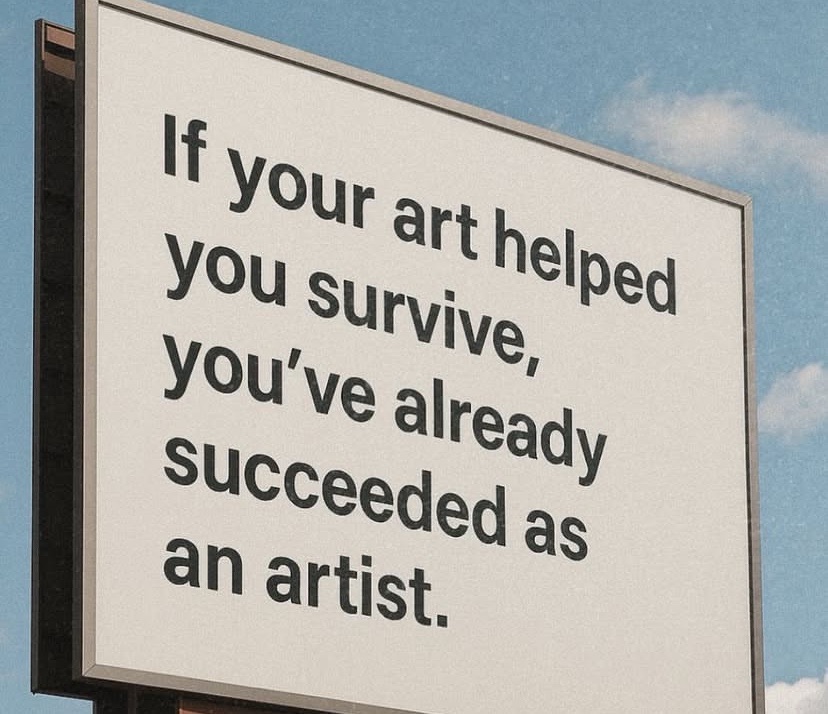
I don’t think it’s a coincidence that this image popped up on my feed while I was doing research for this post:

This is a simple but true statement, and I’d apply it to both your own work and other people’s works. If an artist’s music helped you in any capacity to enjoy your time on this planet, if even one song paints the planet just a little brighter for a moment, it served its purpose. And that purpose is to be a sort of analgesic to the pain of everyday life. That’s what I believe Taylor understands so deeply, and that’s what I hope to embody in my own creative endeavors. The life of a showgirl is to serve glimmers and bring hope.

In a world that is intent on snuffing out anything whimsical, beautiful, or different, embrace that spark that makes life worth living.

If you enjoyed the writing in this post and elsewhere on the site, please consider donating to Jessa’s tuition fund! Any help is appreciated!

CashApp: $TheJessaJoyce

Venmo: @TheJessaJoyce

Don’t Quit Your Day Job: How to Avoid Selling Out and Make Art You Actually Like

I like to read books on the intersection of creativity and productivity. It’s kind of my way of sharpening my mind for writing and creating music. Reading has always been a form of escapism for me, but these diving into these books of practical tips and hard-earned advice have really helped me develop my own philosophy toward art and work. One book I’m working through at the moment is Make Your Art No Matter What by Beth Pickens, which is crammed full of helpful information and philosophical approaches guided by everything from modern psychology to ancient Jewish wisdom. It’s a great book so far, but the second chapter was what prompted me to write this post. It’s a chapter simply titled “Work,” and it delves into all the ways our hectic capitalistic work schedule fucks with our abilities to create.

Here’s a hard truth I’m learning: if you want to create good art, get a day job. I’m not kidding.

If you want to create unadulterated, pure art, free from the expectations of corporations and The Man™, you need to get a day job. Because the second you rely on your art for your income, it’s not yours anymore.

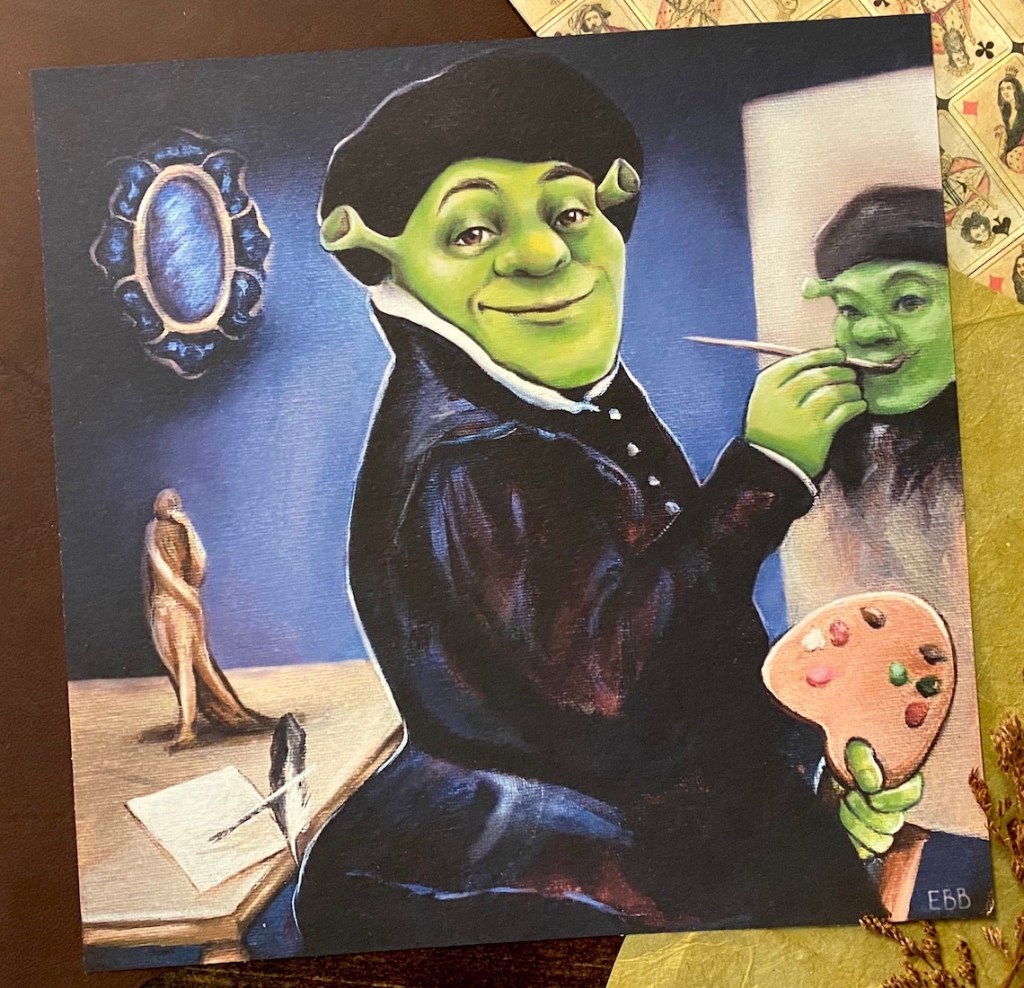
My wife is an artist. I talk about her quite a bit on here. One thing she does for work is commissions. She specializes in doing quick unhinged portraits of people’s fursonas (furry art is a lucrative field, yo). Imagine if you paid $5 of your hard-earned money for a sketch of your character and you got back a lovely sketch of Shrek. You wouldn’t exactly be pleased, would you?

I don’t think I could be mad at this, to be fair.

The second people start giving you money for your work, you owe it to them to give the people what they want.

But if you can make a living independently of your art, you can do whatever the fuck you want with it.

And it’s freeing as hell.

When I was younger, I wished I was Taylor Swift famous. And the truth is, when you’re Taylor Swift famous, you have a little more wiggle room. She has enough leverage to do what she wants creatively. If she wanted to pull a Poppy and go full on metal, she totally could.

And here is proof that it would be absolutely badass.

Here’s the thing: most artists don’t have that privilege. No, not even many artists who are now considered legendary. Take Heart, for example, because y’all already know I’ll take advantage of any opportunity I get to fangirl over them.

Jessa Shuts Up About Heart for Five Minutes Challenge (IMPOSSIBLE!)

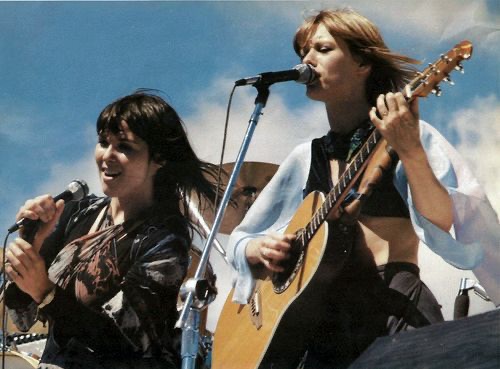
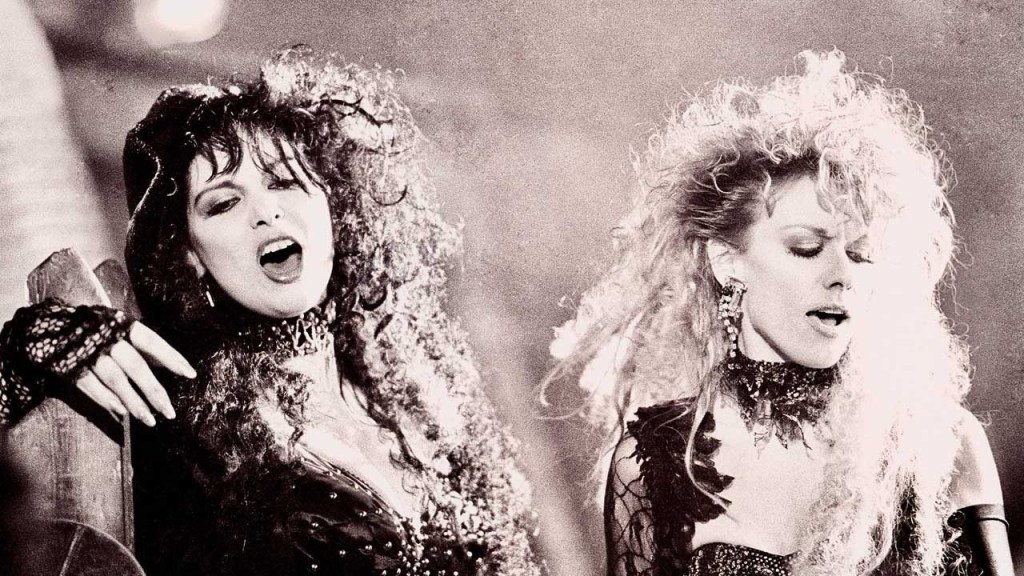
Back in the 70s, Heart took over the rock world with timeless songs like “Magic Man,” “Crazy On You,” and the classic musical middle finger to creeps and sleazebags known as “Barracuda” (which I channeled recently at karaoke when approached by a fucko). But by the 80s, they were reaching a nadir in their career. The industry had changed around them, and suddenly, music was less about realness and artistry and more about manufactured image. The frontwomen of Heart, the Wilson sisters, faced with the very real threat of irrelevancy and the impending death of their music career, decided to roll the dice with what I call the Liz Phair gambit. Suddenly, the band went from looking like this:

To this:

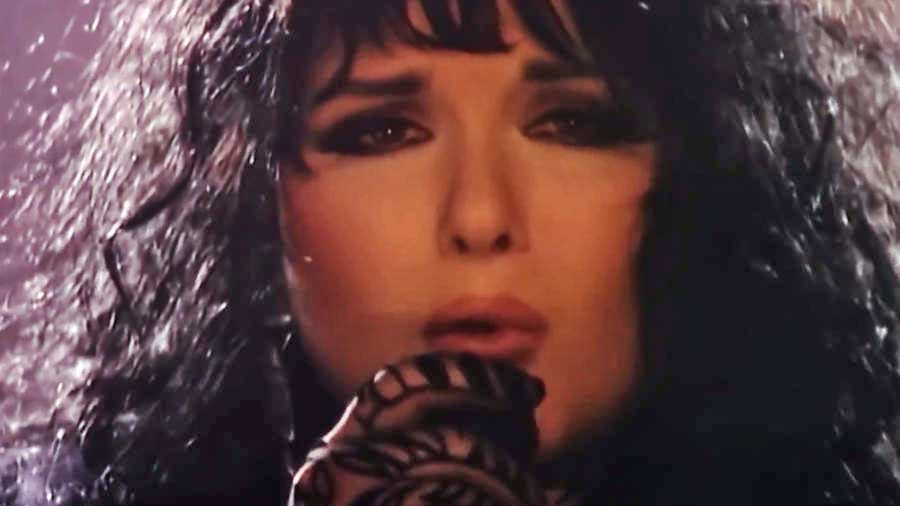
In order to survive, the band had to sell out. And with great success! They scored their first ever number ones during their bombastic, hairspray-fueled ‘80s run. Everyone knows and loves their output during this era. Who can forget the epic power ballad “Alone,” with a music video that was so influential to me growing up that it shaped my entire aesthetic?

But despite all the earthly riches MTV could offer, it really wasn’t the music they wanted to make.

I’ll let Ann Wilson herself do the heavy lifting of explaining the situation in her own words:

“What made me the most uncomfortable in the 1980s when Heart was doing everybody else’s songs was that the songs seemed like the empty fishbowls that you could pour anybody into and it would be a hit,” she said in an interview. “That’s the ultimate example of me biting the hand that fed me. But, at the same time, I’m a creative artist and I want to be authentic and I made this Faustian bargain to do other people’s songs and get No. 1s.”

Sure, she did what she had to do to achieve the rock star life. But sometimes I wonder if she would have been happier tackling the music industry the way I am in the 21st century, working overnight as a caregiver while laboring over her MacBook during the day to make the music she wanted to make. I wonder if I’d be as miserable as she was in the ‘80s, having to sell my artistic soul to have a viable career.

The truth is, I may never see more than the measly excuse for royalties Spotify pays out. I’ll likely never be more than Kalamazoo famous. But at least I can make the music I want to make. I’m not beholden to anyone. If I wanted to scrap my upcoming project, LORE, in favor of a Weird Al-style parody album, I could get away with it. And that’s all because I have financial stability outside my creative work.

I won’t say it’s an easy life to live. Balancing a full time job on top of any passion projects is not a task for the weak. But if you want to make the stuff you wanna make, it’s the best road to travel. It’s okay to work a dumb job you don’t like for the paycheck if it means not letting your art become that dumb job you don’t like.

Selling out just ain’t worth it.

Creativity Overdose: What It Is and How to Fight It

So my wife and a good mutual friend of ours recently staged an intervention in my living room over a glaring problem that’s been worrying them for a while.

(Okay, it wasn’t an intervention, but it sure felt like it, dammit.)

You see, I suffer from something I’ve dubbed Creativity Overdose.

It’s an insidious beast that comes at the intersection of bipolar and ADHD. Creativity Overdose is when your ideas start to come at the expense of people around you. Another good name would be “Eddy from Ed, Edd, & Eddy syndrome,” since it’s basically what he has. Every three seconds, you come up with some hairbrained get-rich-quick scheme or the newest version of The Best Idea Ever™ that consumes your entire being. And that would be fine if you a. followed through on these ideas and b. they weren’t coming at the detriment of your loved ones.

My poor wife has had to deal with approximately 6,348 new ideas since January, and getting back into academia and becoming a specialist on the way AI affects the brain on a psychological level was the straw that broke the camel’s back (I’m shocked it wasn’t my short-lived oil painting business). I don’t envy her for having to deal with my manic ass on a daily basis, and I want to be a better, more reliable partner for her. She deserves that much from me. So here are four ideas I’m putting into practice to negate my struggles with Creativity Overdose and keep the mental and interpersonal peace:

1. Write down your ideas (instead of burdening people with them)

This is hard if you’re an autistic extrovert like me. Sometimes, the neurospiciness kisses the extroversion just right and you feel the need to infodump about every grandiose idea you’ve ever had to your loved ones. I can assure you, they don’t want to hear about it. I know it hurts, but for the most part, it’s true. This is tough love. Nobody wants to hear about your Parakeet Circus idea, especially when the last time you tried to start a Cirque du Soleil featuring parakeets, you blew up three parakeets. Unless the project is cued to be finished or released, absolutely shut up about it. Not everything is about you. (I’m talking especially to myself here.)

2. Write down all of your current projects

Okay, now that we’re not telling everyone all the shit we’re up to, let’s figure out what we’re actually up to anyways. Write down every single thing you’re currently working on, no matter how small or insignificant. My current list has all the musical projects I’m working on, my two jobs, school stuff, my podcast, and even getting my passport. Write down some steps you’ll have to take for each one, too. Putting it all down on paper will help you see how busy you really are and maybe give you a little more perspective on how much you actually need to fill your plate. When you’re excited about stuff, it’s easy to underestimate how much it really takes to get things done.

3. Pick one thing to hyperfocus on for a month

Here is the tricky part. You’ve gotta prioritize. Label the projects on your list from most to least important. Like, “you’ll die if you don’t do this” to “this can wait a few months or even years.” Shelf the stuff that can wait. If writing the book that’s been on your heart for years can wait a few more years, that’s perfectly fine. Like, I’m probably gonna end up releasing Venona at an absolute snail’s pace, but I’m not worried about getting the story out there at this point. Unless something goes terribly wrong, we’ve still got a lot of time on this planet. Don’t worry if you can’t get to everything in the next year or so. Pick one thing (maybe two, since you’ll probably need to pick whatever your main job is for survival reasons) and really buckle down and get it done before moving on. It feels good to get something done for once, trust me.

4. Help someone else create something instead

Here’s something I’m really learning — it’s better to collaborate than work alone, and sometimes it can be just as rewarding helping your loved ones meet their goals as it is meeting your own. My wife wants to be a professional artist and merchandiser, so I’m going to step aside a while and let her work on that. I’m going to take a year off school so she can save for the equipment she needs, and I’m going to support her any way I can. See what your friends need for their endeavors and ask how you can help them. Assisting someone else in reaching their dreams can be a good feeling in and of itself, and it can further inspire you in your own dreams as well. The best part of having creative, ambitious people in your circle is that you can all help each other up.

So what do you think of Creativity Overdose? Have you experienced this in your life? Let me know your thoughts in the comments.

If you enjoyed the writing in this post and elsewhere on the site, please consider donating to Jessa’s tuition fund! Any help is appreciated!

CashApp: $TheJessaJoyce

Venmo: @TheJessaJoyce

More Than Words: Five Quotes I Live By

Do you have a quote you live your life by or think of often?

If there’s one thing I can take away from being a writer my whole life, it’s the fact that words are powerful tools. We can use them to build people up, tear each other down, spread information, spread misinformation, and evoke strong emotions. Something I’ve always been fascinated by is the use of mantras or affirmations for self-improvement. Just repeating a certain phrase to yourself can make an impact on your mental health. And here’s the thing — your affirmations don’t have to be anything in particular, so long as they resonate with you.

Like a favorite quote!

As I began writing this post, I realized I have a handful of quotes I constantly repeat in my head like mantras. They’re the words that shape my personal philosophy and the way I approach life. I never really stopped to actively consider and appreciate how these words have shaped my experience as a human being. But I wanted to share a few of these quotes I carry with me.

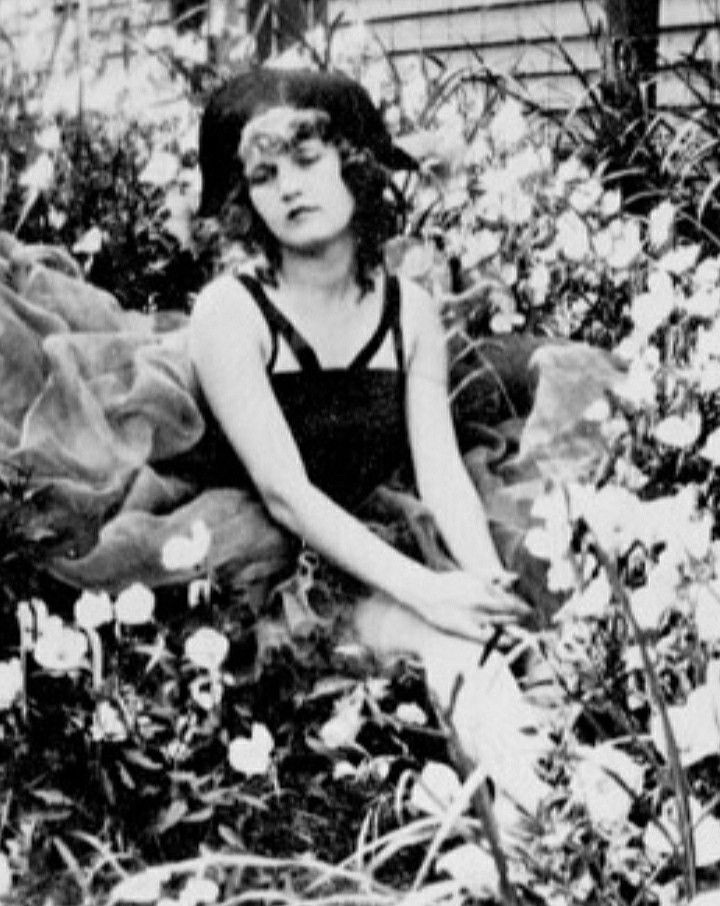
She refused to be bored chiefly because she wasn’t boring.

Zelda Fitzgerald

This first quote comes from the iconic flapper wife of F. Scott Fitzgerald, who absolutely should have been absolutely as famous as him in her own right. She was a Renaissance woman — a writer, painter, and dancer, who went on to die tragically in a mental hospital fire. I see a lot of myself in her story. She was diagnosed with schizophrenia, but had she lived today, she would have received a bipolar diagnosis like me.

Zelda was a wild child with many diverse interests, so I can’t imagine a woman like her would ever be bored. That’s kind of how I want to be. I don’t enjoy being idle, and I don’t ever want to be boring. I always want to be involved in exciting new projects and opportunities. Life’s too short to sit around and be bored. You gotta actively make a life worth living. That’s kind of what the quote means to me.

Show love with no remorse.

-Red Hot Chili Peppers (“Dosed”)

I remember the first time I heard this song and being entirely floored by how beautiful it was. It was in the car with my former drummer Jerry and another short-lived bandmate on the way to our bandiversary date. I’d heard plenty of Red Hot Chili Peppers before that day, but this was the song that really made me appreciate them on a deeper level. I loved the guitar work, the harmonies, and perhaps most importantly, the words.

I’ve always said I wanted this exact lyric tattooed on me someday. I just think it’s a simple concept. You’ve got nothing to lose by giving love freely and joyfully. We need much more love in this world, and now is not the time to be stingy with it. You’ll never regret treating people with kindness.

Never attribute to malice that which is adequately explained by stupidity.

-Robert J. Hanlon

I hesitate to call this a quote. It’s technically a philosophical razor, which eliminates — or rather, shaves off — weak explanations for a particular phenomenon. The phenomenon at hand when it comes to Hanlon’s razor is “Why are people awful to each other?” And the explanation it offers is simple: people just don’t know any better.

Hanlon’s razor is why I still have faith in humanity, even after I’ve witnessed some of the worst of it. People very seldom intend to hurt each other. We’re all just big dum-dums that say and do the wrong things sometimes, and we really need to treat each other with more grace. That’s why I don’t believe in cancel culture — we need a grace culture. If you make an honest mistake and own up to it, that shouldn’t be held against you. No one is perfect, and we can’t hold people to impossible standards.

Do not be overcome by evil, but overcome evil with good.

-Romans 12:21

I struggled to think of just one Bible verse to include, since so many have been influential to me growing up in the church. But this one felt really relevant with some of my recent posts about loving your enemy and fighting the rampant dehumanization of marginalized folks in our society. It’s easy to lash out against the people who are hurting me and my loved ones. But you have to remember that they’re human and they’re hurting too. Hurt people hurt people. It’s not an excuse, but it’s an explanation. And it’s why I choose love — because you don’t know what someone else is going through.

The verse immediately before this one talks about how offering your enemy water when they’re thirsty is akin to heaping hot coals on their head. The Good Book is telling us to kill them with kindness. I saw a post recently that said the true test of a Christian is not whether they love Jesus, it’s whether they love Judas. I’ll admit it’s hard for me to show love to the people who hurt me. The human part of me wants revenge. But the divine answer remains to be love.

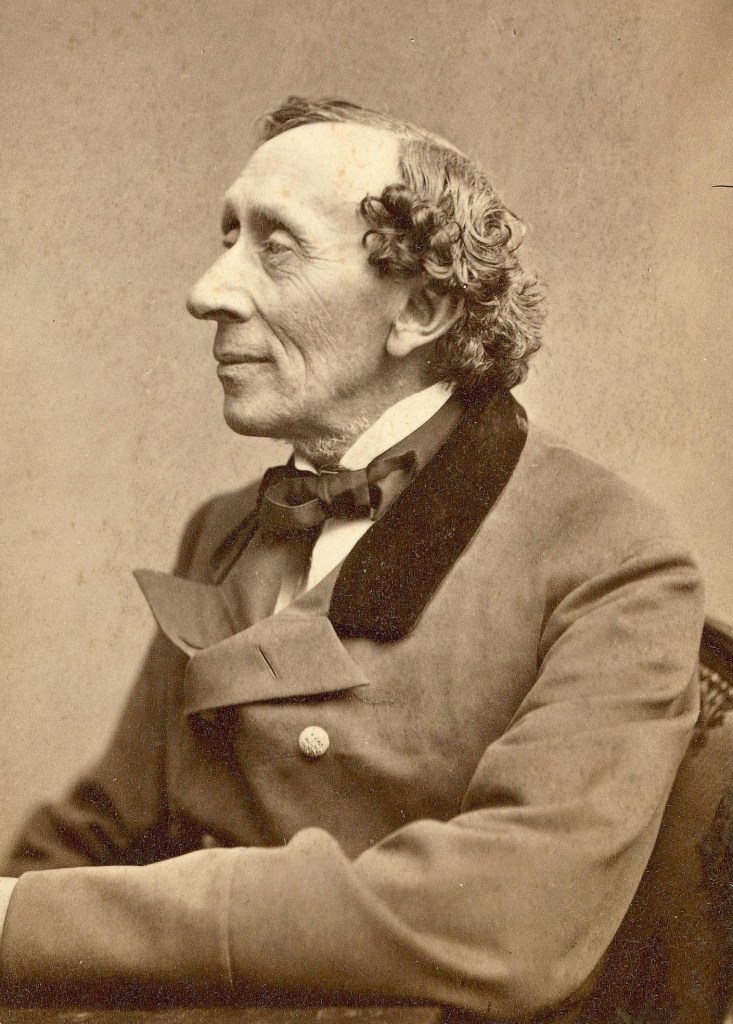
Where words fail, music speaks.

-Hans Christian Andersen

I’ll admit I never knew the person behind this quote was none other than the Danish purveyor of fairytales such as The Little Mermaid, The Emperor’s New Clothes, and Thumbelina. But I’ve always related to this quote. As a child, the signs of my autism were very apparent. I would often stim by pacing or making bird sounds, and I had sensory issues surrounding things such as loud noises and upsetting smells (looking at you, ranch dressing). And like many autistic kids, I struggled to communicate with my peers. My classmates thought I was from France for the longest time because I never spoke in elementary or middle school, so they assumed I had an accent or didn’t know English or something.

But then I picked up a guitar, and everything changed. When I learned to play music and started performing, that was when I truly found my voice. Music was my way of reaching out into the world. I call music my first language for good reason. It was the bridge that connected me to other people for the first time in my life, and for that, I’m forever grateful.

What quotes do you live by? Leave your favorites in the comments!

If you enjoyed the writing in this post and elsewhere on the site, please consider donating to Jessa’s tuition fund! Any help is appreciated!

CashApp: $TheJessaJoyce

Venmo: @TheJessaJoyce

The Entertainer: How I Found My Life’s Calling

I write this from the fancy-schmancy professional studio I’ve been holed up in for the entirety of spring break. It’s almost 2 in the morning, and going by track records here, my bandmate and I won’t be leaving until 6, if not even later. The only thing I have to eat is a jar of cashew butter I shoved into my guitar case. I’m running on Adderall, enough caffeine to kill a horse, and a brief power nap I took hours ago. But as much as I want to complain, I can’t.

This is the life I chose, you know?

When I was a kid, this is the kind of stuff I’d dream about doing someday. I don’t think I can overstate how influential music was to me growing up. I’d watch Behind the Music religiously and dream about the day I’d be in my heroes’ shoes. I’d even imagine my own episode someday, all of my wild ups and downs throughout my career. Music was a mystical thing and I had my own pantheon — Bon Jovi were gods and Ann and Nancy Wilson were my goddesses.

I’m not actually goth, I was just really influenced by the music video for Heart’s “Alone.”

This past week, I’ve spent five nights and one long day doing what I’ve been wanting to do for years — work as a professional musician. I feel like I’m so close to phasing out any form of “real work” and just doing what I love, and it feels great to be honest. I’m sick of menial unimportant work. I want to do something with meaning.

For a long time, I assumed my role on this planet was to help people in a really real and tangible way. In high school, I was insistent on becoming a doctor so I could do just that (and for the clout of being able to call myself a doctor, obvs). Of course my parents talked me out of that career path, and probably for the best, because knowing how flaky I can be, I’d probably be the person who leaves a scalpel in a patient or something.

Which is more common than you’d think.

But even after I left my shallow dreams of doctorness behind, I was convinced I’d someday be a music therapist, and that was going to be my method of helping people. My first love has always been music, so I knew that had to be involved somehow. It was the perfect arrangement — I’d get to do what I love and also help people. Alas, those dreams didn’t pan out either, no thanks to my nightmarish internship that soured me to the entire profession I’d been pursuing for a decade.

Which leads me to where I am now. I host music bingo for a living. I put on trivia shows for local bars. I’m studying audio engineering and on special occasions, I get to be a studio musician and help out with recording guitar or bass. Nothing I’m doing is groundbreaking or livesaving. No one needs a game of music bingo. But I’m content, because the things I am doing are still important in their own way. I talked a little about serving glimmers as an entertainer on here, but it stands repeating. Entertainment and the arts are crucial to every day life because they’re an intrinsic part of being human. It’s why I’ve got mixed thoughts on AI. Art and humanity have been linked since the dawn of civilization. It’s what makes us different from other creatures, even relatively intelligent ones like dolphins.

Try making art with flippers, you untalented swine.

We need arts and entertainment. It’s the thing that keeps us sane in this hectic society. And honestly, it’s a huge honor work as an entertainer. I love what I do. I love putting smiles on people’s faces. I used to think working in entertainment was selfish. After all, I only want to do it because I love attention, right? And I mean, I do enjoy being the center of attention, but there’s an altruistic element to it as well. Making people happy — just giving people something to look forward to in this dark world — is what keeps me going.

I’ll end this sort of rambly blog post with an anecdote from my freshman year of college. I was very casually dating the sweetest, gentlest guy. He was smallish in stature and cute in a nice Jewish boy way and really, really loved sloths. My point is you’d never expect this young man to play guitar like a fucking rock god, but he did. He could shred. And he had such a way with crafting beautiful songs. We didn’t work out for reasons I’ll never know, but I was madly in love with him. That’s not why he holds a place in my heart to this day, though.

One night, we were sitting in the car. He was showing me Buckethead, one of his biggest influences, alongside John Frusciante, whom I also came to love. And my sweet kinda-boyfriend revealed to me the meaning behind his band’s name, Smiles and Anchors. He wanted to honor his passion for making people happy through music. That’s all he wanted to do. It wasn’t about becoming famous or rich. He just wanted to bring a little light to people in his little world.

And that shook me.

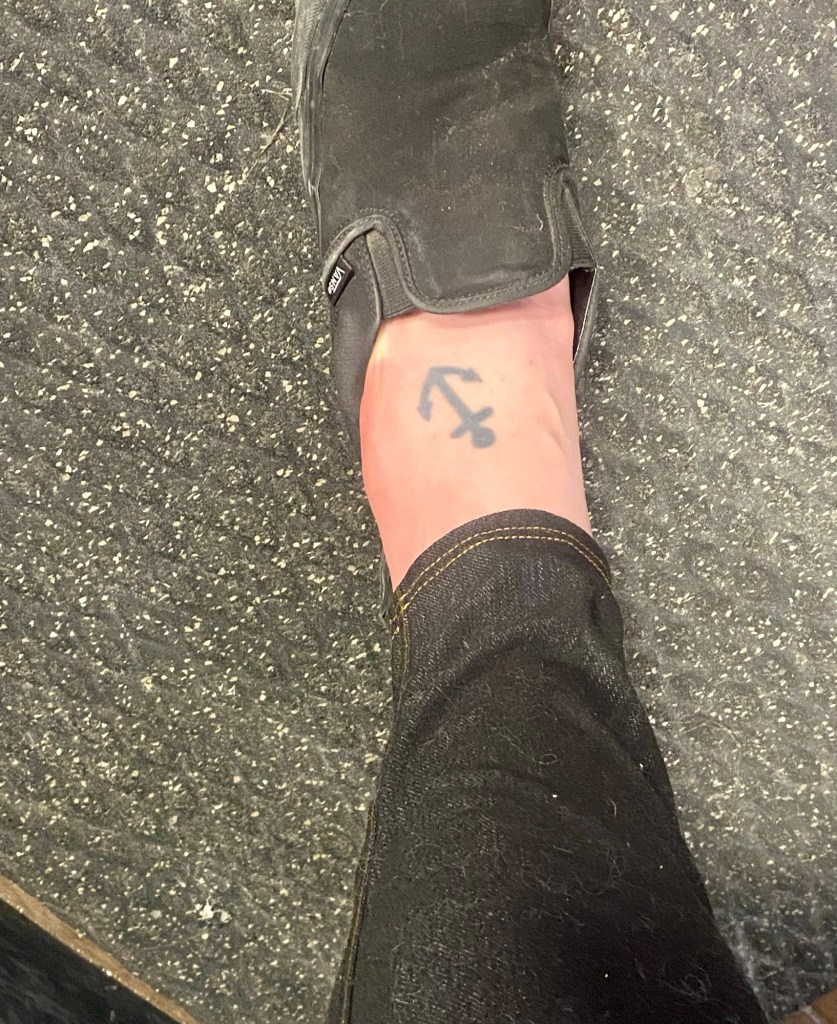
Music has always been my way of connecting with others, but I’d never heard anyone put it that way before. Until then, music was more about what it did for me. It made me happy. It made me connections with others. But what about the folks listening? To them, we’re the ones making life a little more bearable. We’re the ones providing the soundtracks to memories. And it’s kind of humbling in a weird way, and I like that. I never want to lose sight of why I play music. I never want to let my ego soil the joy I get from making my listeners happy with my songs, because it’s not about me. It’s about them. That conversation was part of the reason I ended up getting an anchor on my foot for my first tattoo. I wanted a physical reminder to stay humble, no matter where music takes me.

I intentionally censored my horrendously long and upsetting toes. You’re welcome.

And that’s what being an entertainer is all about to me. It’s hard work. It’s scary. You have to put yourself out there. You have to practice a lot. Sometimes you’re in the studio for so long your contacts practically melt into your eyes and you get a gnarly case of conjunctivitis (true story). But for all the sacrifices this lifestyle takes, it’s worth it. Being a performer has been some of the most rewarding work I’ve ever done, and I’m happy I get to share it all with you.

AuDHD Dreams and Impulsive Schemes

When I opened my app to check my site’s stats for the day, this little prompt popped up:

Describe the most ambitious DIY project you’ve ever taken on.

I’ll be honest, this is a hard question for me, and not because I’m like, the queen of all things DIY. I’m not even a baroness of all things DIY. The world of DIY is a mystical land with which I am simultaneously very familiar and also very much a stranger.

Welcome!

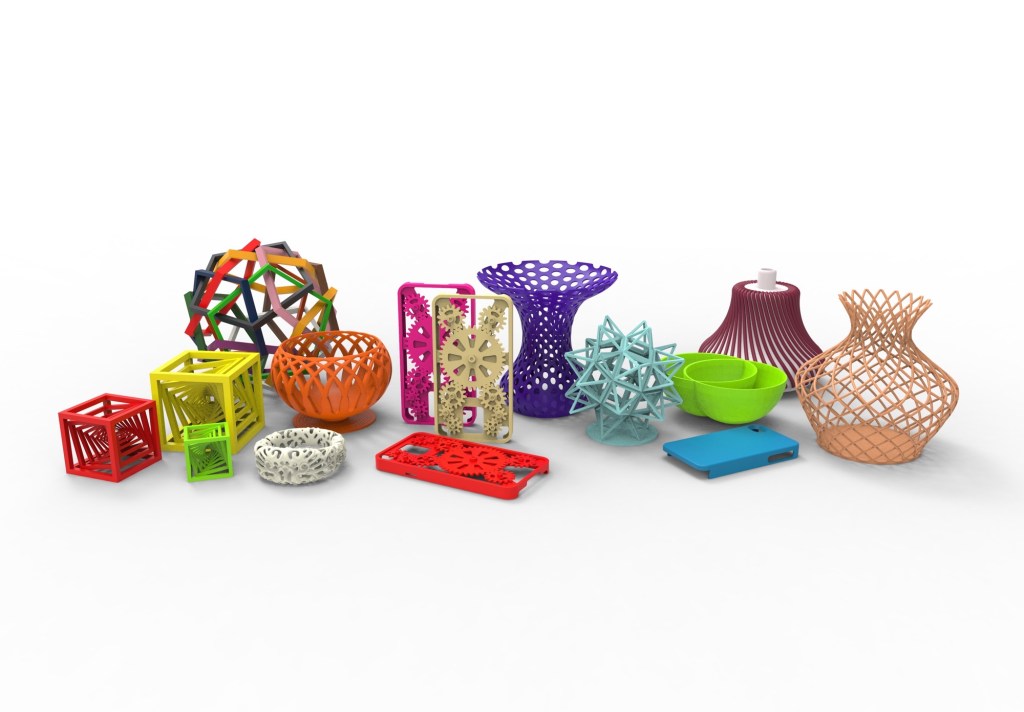
The truth is, I often cycle through creative interests, sometimes very rapidly! I can recall flipping through like, five different artistic outlets in one summer before finally realizing I sucked at all of them. I have music and writing already — maybe it’s what I get for being greedy with the fine arts. But one of my best friends is also a musician and writer, and they also have time to make bead art, crochet, sew shit, put together enormous puzzles, and 3D print whatever the hell they can’t make doing everything else.

Allow me to print you a fucking vase.

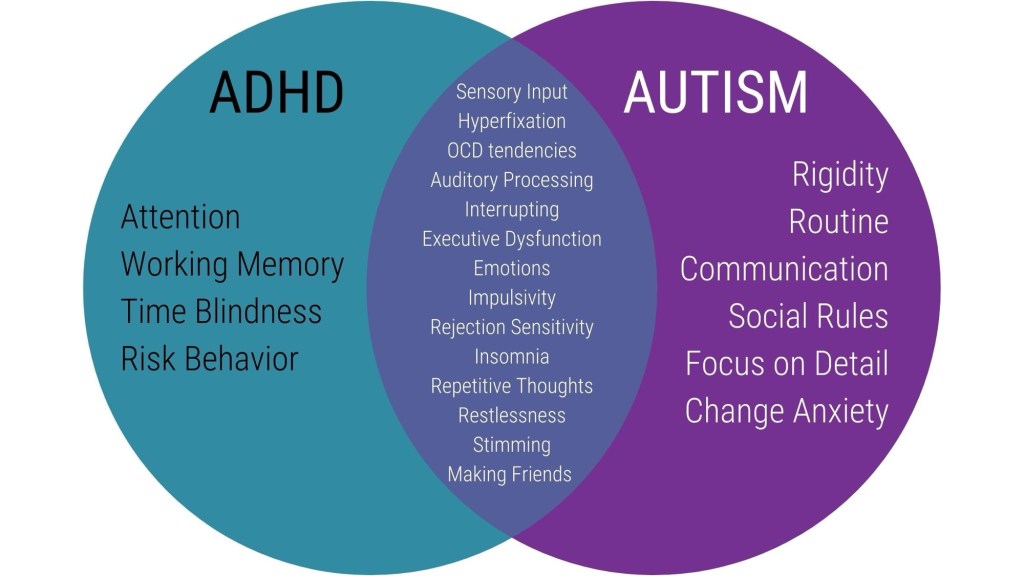
My problem, as always, is my brain wiring. I’ve got the fun combination of ADHD and autism, and they love to fight sometimes.

If this infographic isn’t me…

One of autism’s defining traits is the presence of “special interests,” or things were just really fascinated by and want to learn everything about. As a child, it was 8-track tapes and parakeets. In adulthood, it’s been lost architecture and cults (I dare you to let me tell you about multilevel marketing cults for hour). Not every autistic person gets special interests like this, but it’s incredibly common and definitely marked my experience growing up autistic.

That’s just one of the ingredients in my particular brand of brain soup.

It’s actually alphabet soup but all of the letters are “ADHD.”

ADHD comes with impulsivity. It’s one of the main symptoms, in fact. I technically have inattentive type ADHD according to my psychiatrist, but I’m shocked I didn’t qualify for the hyperactive-impulsive type instead. The hallmarks of my ADHD have always been the impulsive and hyperactive behaviors. And when I get an impulse to try out a new hobby, I gotta dive right in, headfirst, without checking the depth of the water beforehand.

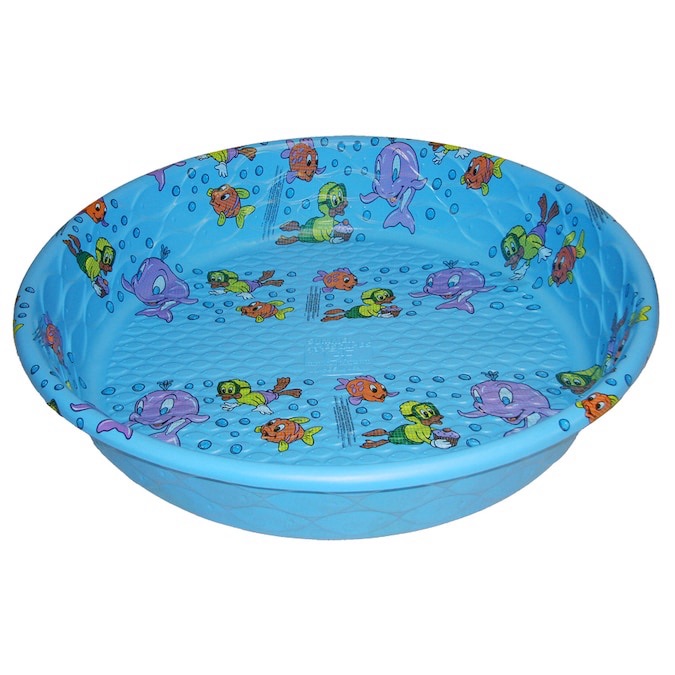
And this is the pool.

It was pretty detrimental for a while because I was blowing all my money on these hobbies I’d be into for only a week or so before giving up. There’s the thing — if I wasn’t immediately good at the hobby, I quit. I also didn’t have the patience to get good at anything.

I realize I haven’t actually answered the prompt at hand yet (which is another very ADHD thing of me to do), so allow me to list the top five lofty DIY projects my neurodivergent ass stupidly took on:

5. Boating

I’m not quite sure this counts as a DIY project because I didn’t really make anything, but it was lofty nonetheless. Do you know what all you need to safely operate a boat? A lot of shit, that’s what. Yet I ordered a whistle and high-powered flashlight and lifejackets, all for the little inflatable boat I bought while we were living on the lake. How many times did I actually use the boat? Exactly once. It was a magical time, don’t get me wrong, and I wrote a song about the experience, but that song basically costed me $600. (And this is why I have credit card debt.)

4. Perfumery

I don’t know how many of you remember my witchy phase, but I definitely dabbled in the mystical realm for a while. Still do, to a lesser extent, but at the height, I was really into making my own “potions” out of herbs and essential oils. This inevitably led to me making potions not for magical properties, but because they smelled really nice, and giving them to my friends and family. I also made a lot of spell jars around this time, containing stuff that reminded me of the folks I made them for. It was kind of a cool hobby actually. I still have a lot of spell jars from that era.
3. Sewing

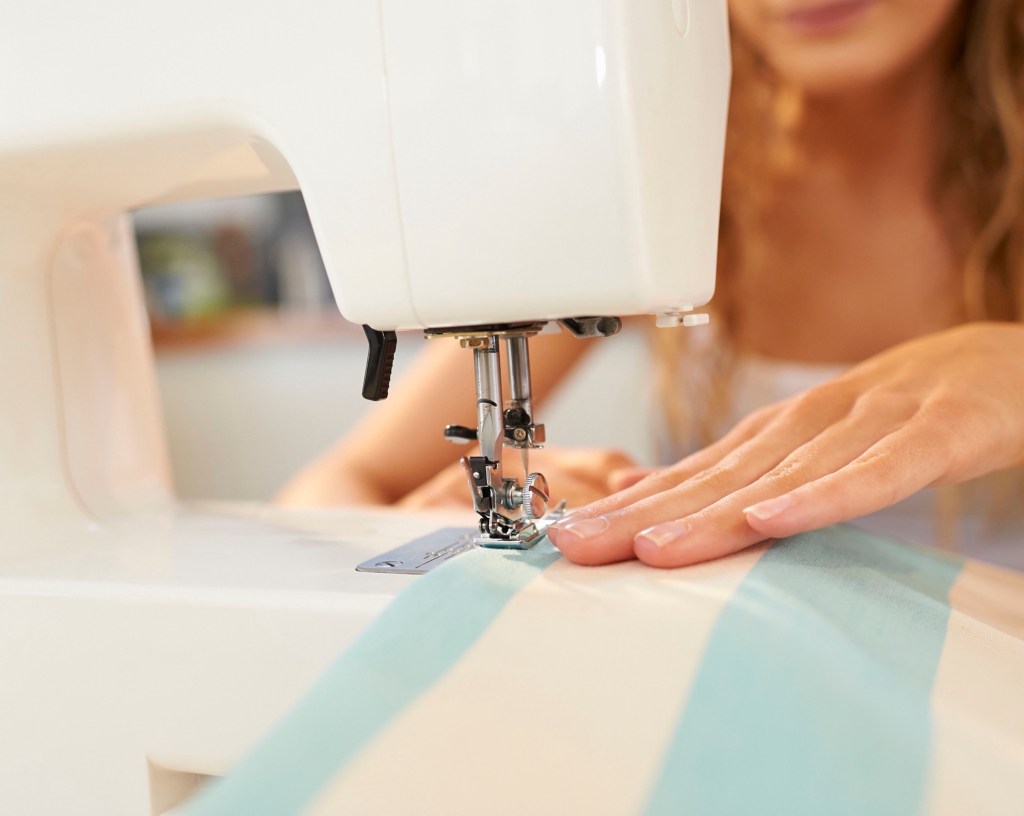
This was the shortest-lived of all the hobbies listed here. I went to JoAnn’s (RIP) for a small sewing kit because I wanted to alter my Chappell Roan costume to make it a little sluttier. Like, I wanted to show kneecaps. And the nice very gay man helping me suggested I also try a pillowcase. Not wanting to disappoint a fellow gay, I happily bought material to sew my own pillowcase as well. When I got home, I immediately got too overwhelmed and threw the sewing stuff behind the TV to hide my shame. It remains there to this day, and the Chappell costume remains unslutty.
2. Painting

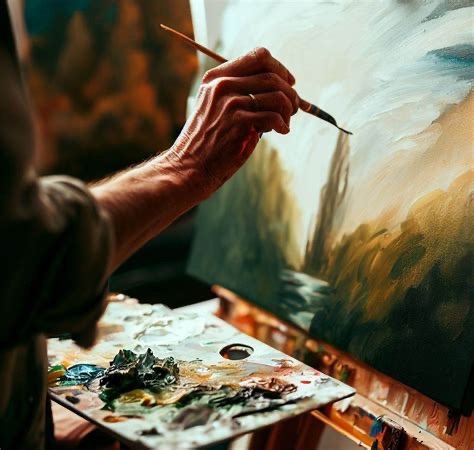
Of all these hobbies, this one has been the most successful, if only because I’m not a stranger to visual art. I do digital art and coloring pretty regularly with my iPad, but traditional painting is a whole different beast. My college guitar professor was an incredibly skilled oil painter and I always really admired him, so I figured I’d try my hand at it as well. And I got some pretty okay results!

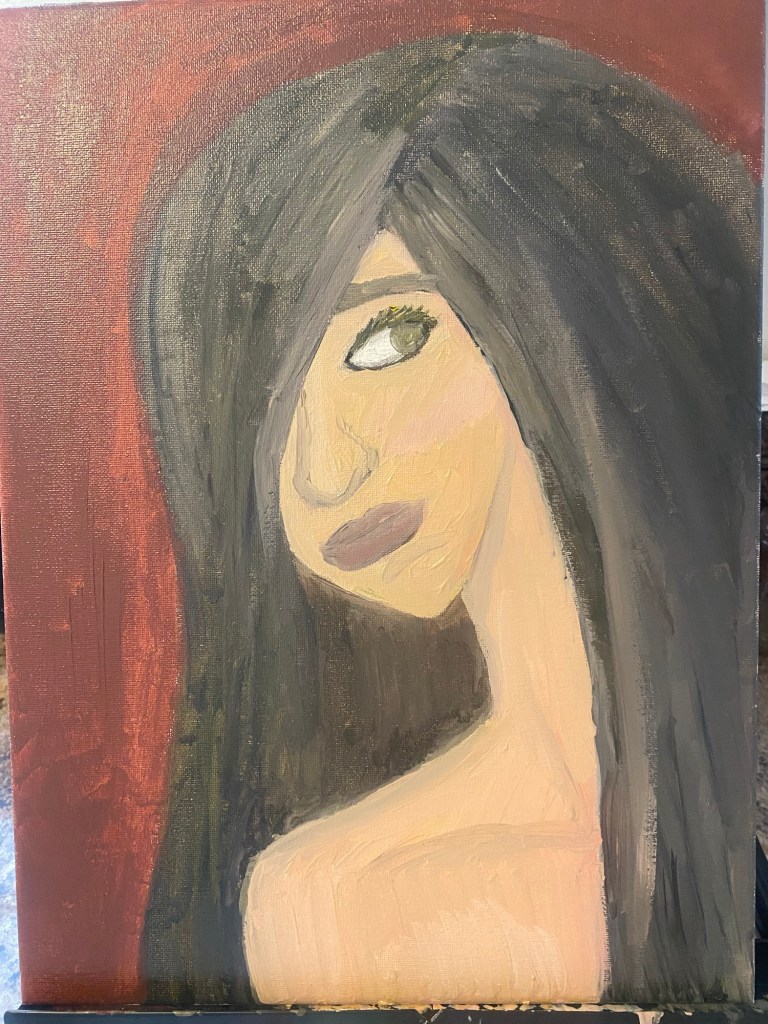
This painting of my girlfriend’s girlfriend turned out better than I anticipated, although she didn’t want to keep it (to be fair, what would you do with a painting of yourself??). I think I’d feel better about this hobby if I had some success selling my art, because for now it’s just kind of languishing in my apartment. I still have the equipment for oil painting, so I could easily revisit this one if I wanted.

1. Crocheting

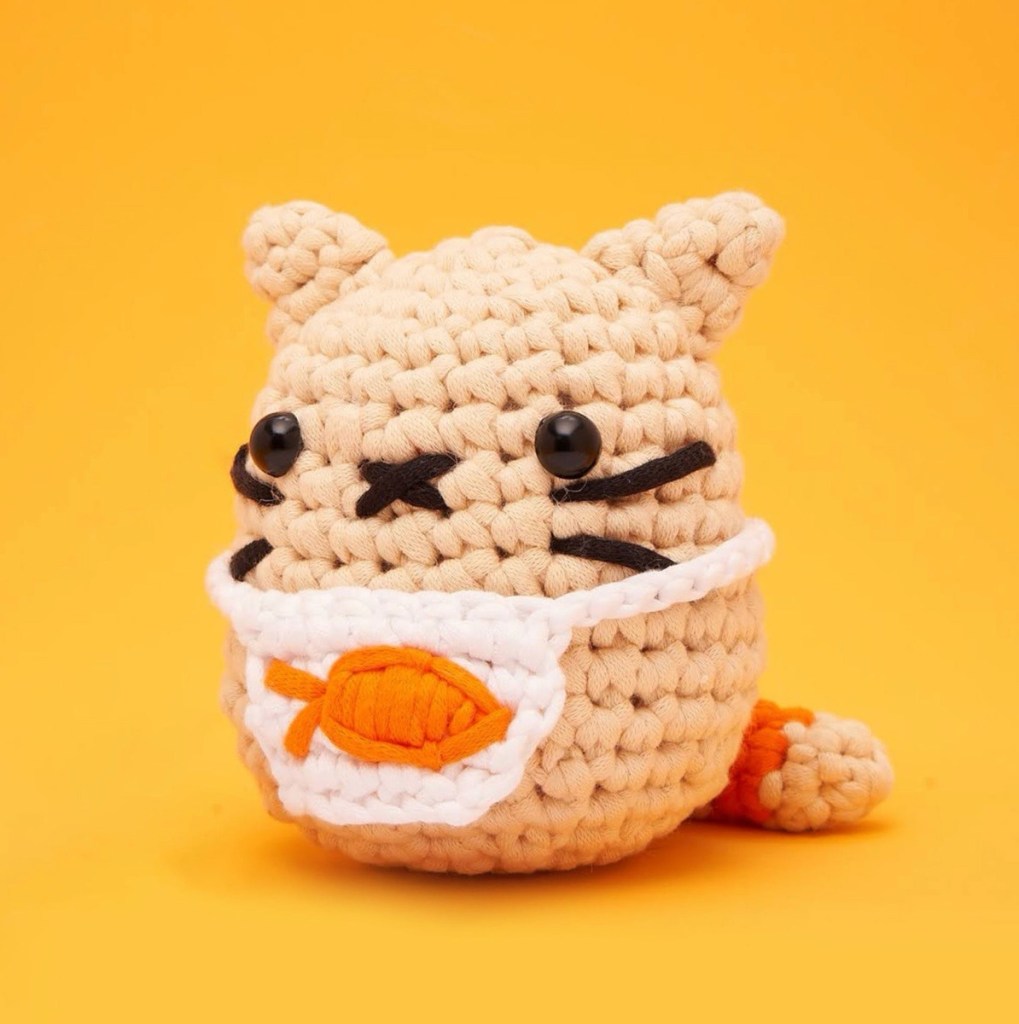
Ah yes, the most tragic one. The one I had such high hopes for. I always imagined myself knowing how to crochet someday, probably as a little old lady sitting on a porch swing with a glass of sun tea. It was just part of how I envisioned being a grandma, and now that I’m officially an age where I can be a grandma (like, I just saw a report about a 32-year-old grandmother), learning to crochet seemed like the next logical step. So I ordered a beginner’s kit from the Woobles and well, here is the expectation:

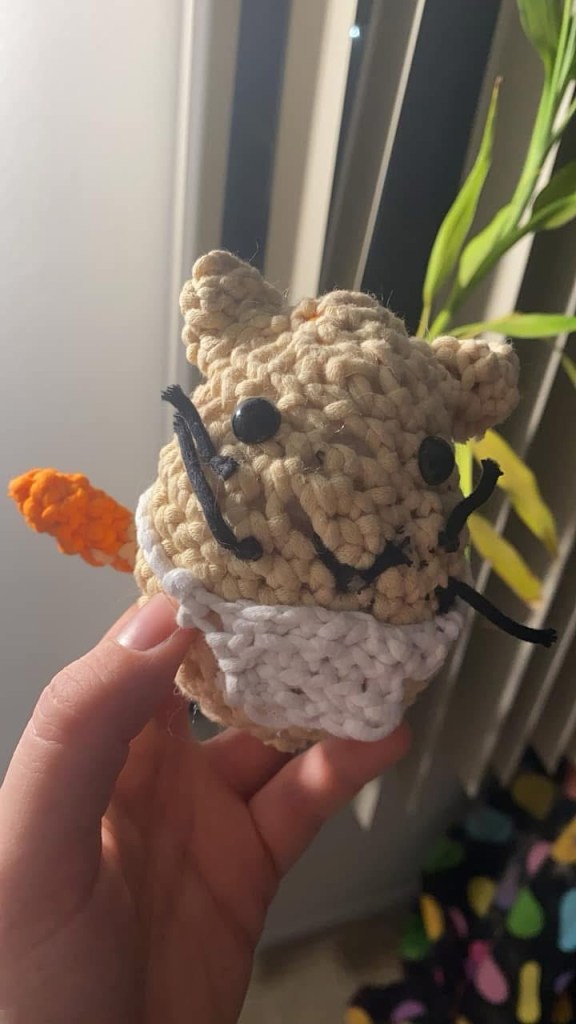
…and result:

You can almost hear it crying to be put out of its misery. This cat potato was eventually given to my girlfriend as a Valentine’s Day gift, and I think her car ate it. My one and only crochet attempt, lost forever.

Although maybe that’s for the best.

Almost Icarus: What I learned “Writing” an Album With AI Software

This might be my most controversial blog post yet, moreso than any of my posts on religion or politics. Like, I could lose my Artist™ card over this transgression.

You see, I have sinned. I wrote an album using AI software.

Not a song.

Not even an EP.

A whole ass album.

I realize that sounds bad, and it kind of is. Bear with me.

“First you use AI, now you’re saying you have a bear with you. Can we even believe you Jessa??”

I’ve discussed AI in depth on here before, and to be honest I was a skeptic before I met a good friend who introduced me to the software. It was simple enough — you input a prompt (or a full set of lyrics if you’re really fancy), and out pops a song. And the songs it spat out were not robotic or mechanical at all. They sounded extremely realistic, all with breath sounds and guitar string scrapes and lifelike vocals. There was no uncanny valley — that valley had been crossed.

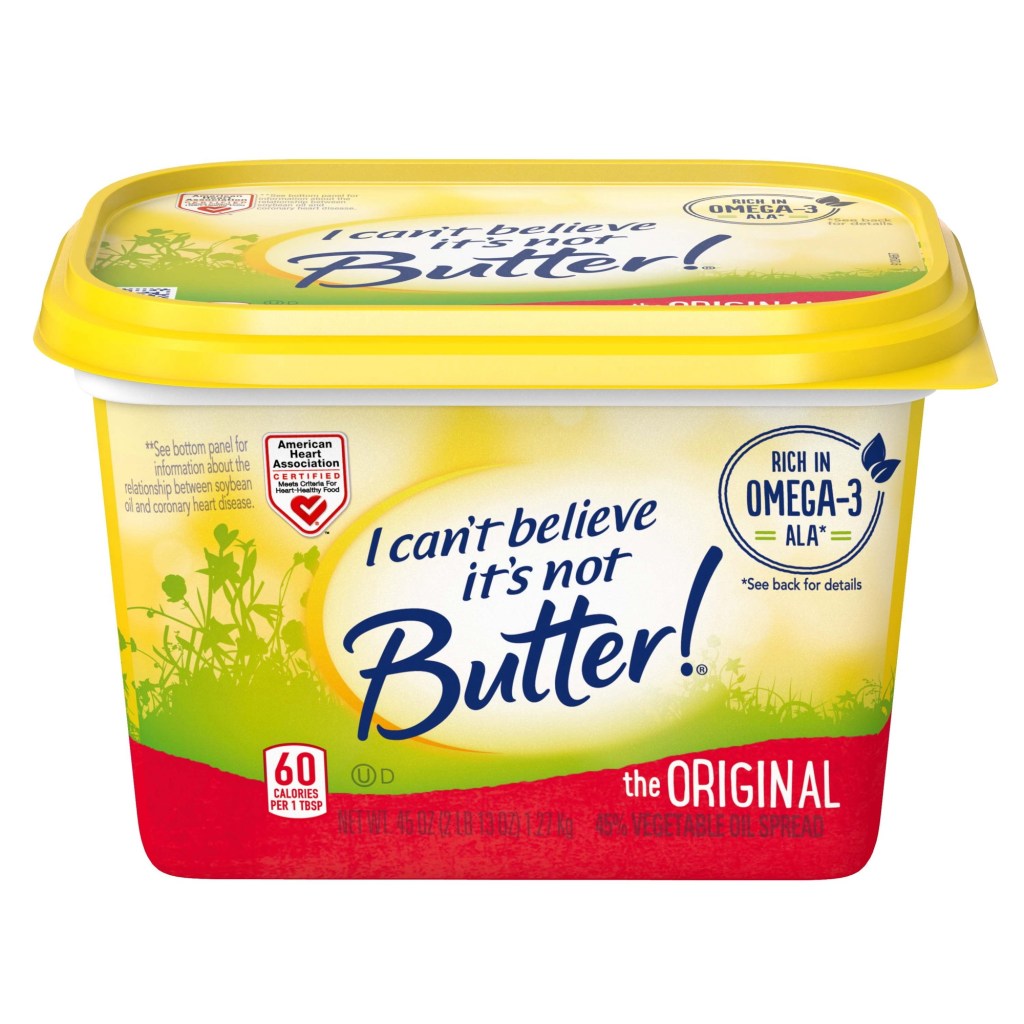
I can’t believe it’s not a real song!

The friend was using the software because they don’t play an instrument, but wanted to write songs, which I mean, I definitely get that. I can’t shame someone for wanting to bring the music in their head to life. That’s what I’ve spent my entire life trying to do myself through songwriting.

But one night, I was bored at work. They say that idle hands are the devil’s playthings, and the little red man was feeling especially feisty I guess. So I downloaded the software myself and plugged in some of my unused lyrics along with prompts that reflected the kind of music I wanted to make. I figured it wouldn’t hurt to generate some ideas to glean. And holy shit was my mind blown. Suddenly I had one, two, five songs that were literally already complete, and according to the licensing policy of the particular software I was using, I could do whatever the hell I wanted with these songs. I could post them, remix them…

Pull it to the side and get all up in them.

I could re-record all of the songs I’d beep-booped and release them myself. It was genius! This was going to streamline songwriting in ways I’d never imagined. Suddenly, I was writing lyrics to see what the software would spit out. It was almost addictive.

But it didn’t come without a cost. I felt a twinge of guilt whenever my girlfriend would mention an anti-AI post. I knew what I was doing was technically cheating, but the dopamine hit from hitting “create” was too strong. My imposter syndrome was getting worse because of it. I’ve been writing music since I was 14 — how the fuck was a computer writing better songs than me? It was almost disheartening. Nothing I tried to come up with on my own compared to the full songs this software came up with in ten seconds.

Not to mention the fact that my taste in music was now borked. I now had all these songs I’d created and curated specifically for my own taste in music, and nothing else compared. I wasn’t getting “hyperfixation” songs like I used to because all I wanted to listen to were my creations on repeat. I needed to squeeze all of the joy I possibly could out of them because nothing else was satisfying.

The songs after I sucked the life out of them.

So here we are now, with me stuck with 12 songs I only half wrote and don’t know what to do with. The conundrum I find myself in is that these are not only good songs, but personal songs. I used some deeply personal lyrics I couldn’t find a melody worthy of in order to make some of these songs. There’s a song about recovering from my rape, there’s a song about how I probably won’t ever get to have a kid, there’s even a song about how I’m willing to go to war to defend my girlfriend from Nazis. I tried rewriting them but nothing sticks like the fucking AI songs. At this point they’re more than songs. They’re demons I need to exorcise.

And the only way I can exorcise them is by re-recording them and releasing them into the world.

I wanted to write this blog post before I post anything from this album just because I don’t feel ethically sound releasing something made with AI without disclosing that detail. I came to love these songs and I hope you do too, despite their origin. They’re still very much my work lyrically, and I’ll do my best to make it musically own as well. It’s unsettling how close some them already sound to songs that came directly from my noggin. “Fire” is a sexy rocker to “Sweet Honey,” and “WTF” could be considered the sequel of “Chrysanthemums.” I’ve been trying to think of some way to frame the release of these songs as a social experiment — will the music I created with AI be more successful than music created entirely by humans — but truthfully, I just want to get these songs out there in some fashion.

This blog post comes with a warning — if you’re a creative type at all, use caution when utilizing AI software, because it will erode your actual skills if you’re not careful. That’s not to say it won’t have any legitimate uses. I can see it being used in music therapy settings with a lot of success, and I’ve heard of nerdy types using it to make songs specific to their D&D campaigns. Hell, I can see it being used to get ideas during a bad writer’s block, so long as you don’t lose your own voice. But therein lies the problem. AI is like fire — it is a tool, but you have to remember, it’s still fucking fire. It’s almost eerily fitting that the software I used contains the word “sun” and one of the songs I made with it was one named “Icarus.” At first I wanted to believe I was Bernie Taupin and the AI was my Elton John, but if I’m honest, I was Icarus and the AI was my sun.

It’s not flying, it’s falling with style.

I don’t harbor any ill will toward the friend that showed me the software or even the software itself. I’m glad the songs I beep-booped into existence exist now, even if I wish the circumstances behind their existence were different. I don’t know if I’ll ever write anything with AI again after this project is properly exorcised. My next project is a concept album that’s almost finished lyric-wise, and I’m so tempted at times to pump them into the software and see what it comes up with, but I’m restraining myself as best as I can. I want to see what I can come up with this time.

I kind of miss the process of creating, and im tempted to make my next project entirely analog for this reason. I miss that hands-on feeling. When I was at my girlfriend’s apartment this weekend, I toyed with her synthesizer and recorded a handful of catchy riffs with my phone. They’re not full songs, but they’re starts. And most importantly, they’re mine.

Technology Marches On: A Musician’s Perspective on AI

This is going to be a controversial post. So hold onto your butts, dear readers.

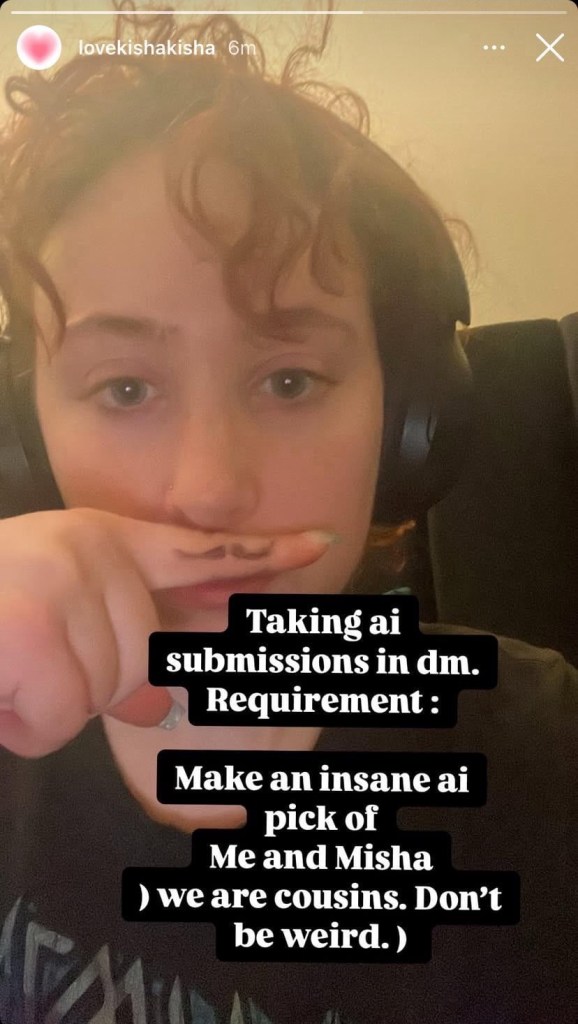
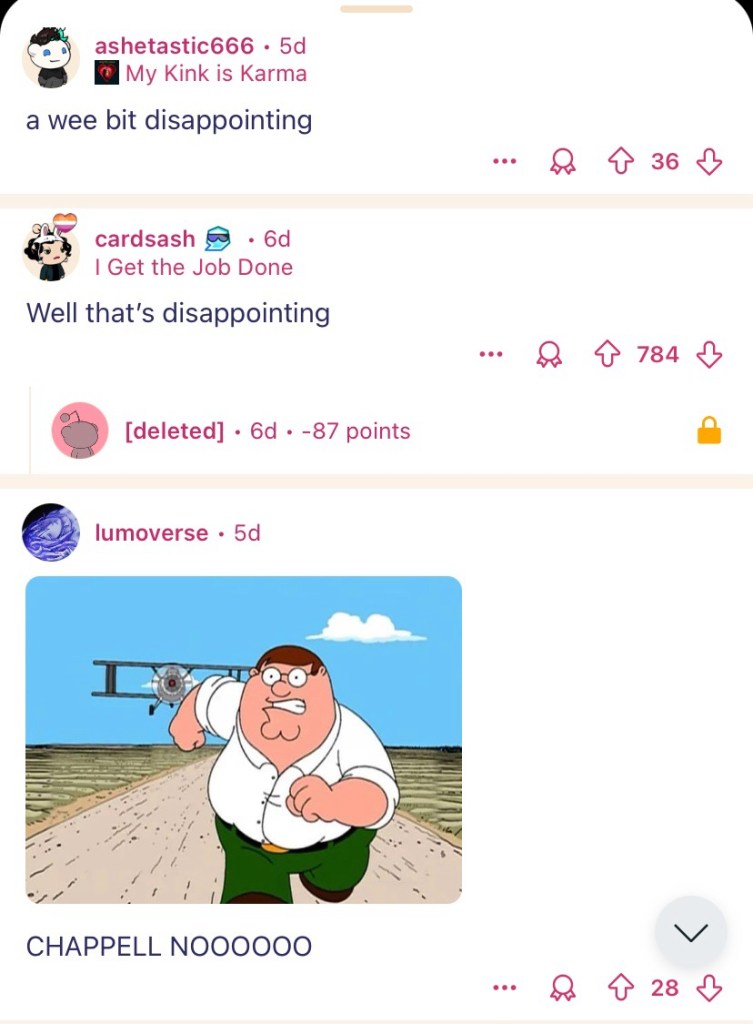
A few nights ago, Reddit’s r/chapppellroan community was abuzz, and not in a good way. The red-haired pop songstress invited controversy when she asked her fans to create unhinged AI images of her and her cousin.

Also embracing the millennial finger mustache, which I thought we collectively decided to forget about.

The overwhelming response from her fandom was, well, scathing. A lot of fans were disappointed, to say the least.

CHAPPELL NOOOOOO

And they have reason to be. Artificial intelligence is an ethical landmine. I’m not even talking the environmental impact — remember, training a single bot can produce as much CO2 as five cars do in their lifetime. It already has the potential to put visual artists out of work, and honestly, music isn’t far behind. There are already fully AI songs charting. Being wife to a visual artist and a musician myself, you’d think I’d be as strongly against AI technology as Chappell’s fans. And for a long time, you would have been right.

But I’m not anymore. In fact, I think it can be useful — used correctly.

A good musician friend of mine introduced me to a certain software that utilizes AI to create full, complex songs out of, well, whatever you give it. I was hesitant at first, but one night, I was sitting at work bored to death. On a whim, I decided to flesh out some long-abandoned lyrics I’d written and toyed with the software a little. And I was shocked at how well the software could bring my visions to life. It hit me that I could use this technology to break through writer’s block. After all, according to the software’s terms of service, everything you beep-boop is yours to do whatever you want with. I could flesh out entire demos using AI!

And I can repeatedly listen to my own music like never before!

Let me be clear — I don’t support simply releasing what the software spits out. I think it’s disingenuous to put something out into the world and claim it’s yours when all you did was punch a few buttons. But I don’t see an issue with using it to glean ideas and visualize what you actually want to create. It’s the same concept for visual artists. Use AI to generate some poses or brainstorm ideas, but at the end of the day, your art is what you create yourself with your chosen medium.

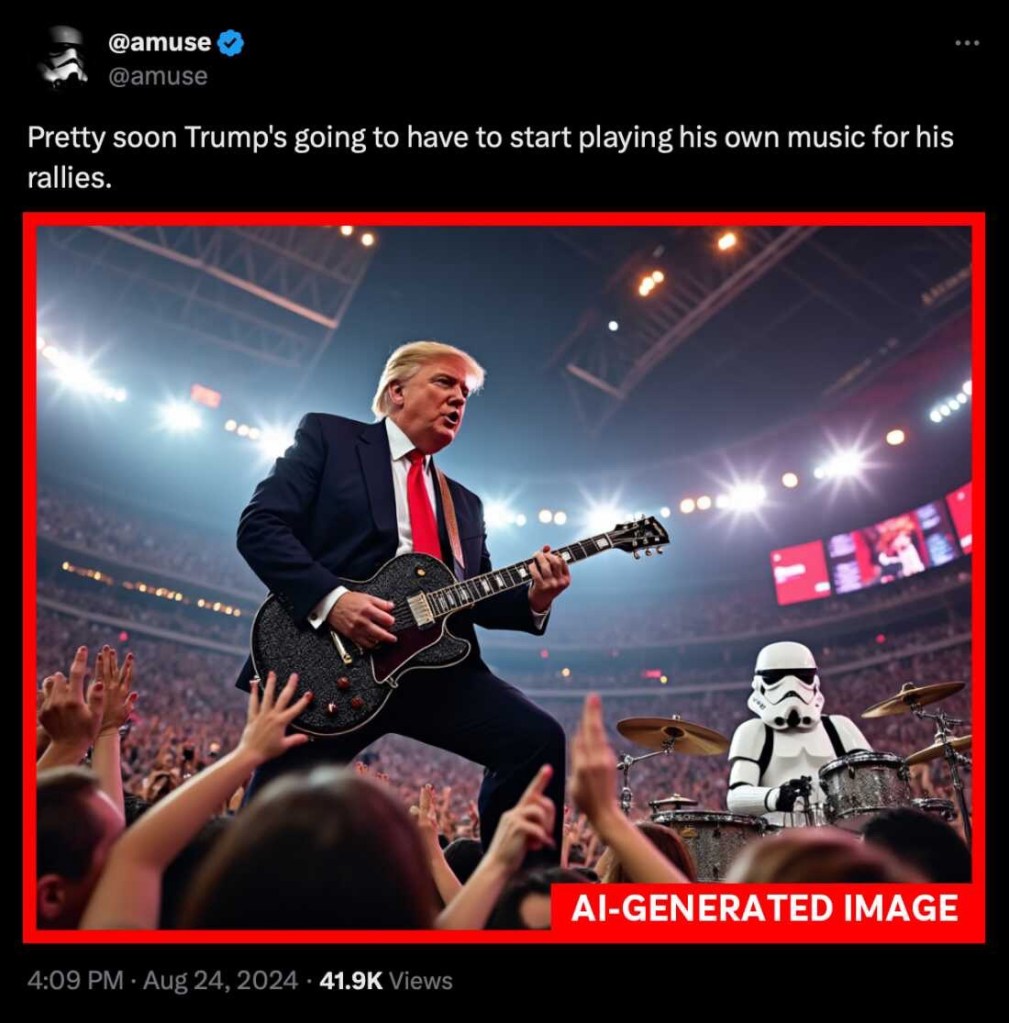
I know it’s really easy for bad actors to use AI for insidious purposes, and I can’t argue that. Sure, making cute realistic neon owl families with AI is innocent enough, but what about Joe Biden and Donald Trump swordfighting with their penises? We have the technology to make a very convincing image of that…atrocity, and publishing it to social media has the potential to damage real people. For that reason, I think there needs to be significantly more legislation surrounding AI (or people are going to develop some really wild ideas about American politics).

Like people believing this man can actually shred.

Still, I don’t think AI is an entirely bad thing. It’s a tool like anything else, and every time a new creative tool comes out, people will declare it the enemy of true art. Painter J. M. W. Turner once said “This is the end of Art. I am glad I have had my day.” This quote was spoken in 1839 and is referring to the daguerreotype. But we still have painters to this day. And now that the technology exists, you can’t put the genie back in the lamp. Like it or not, AI will be a huge part of our future. As the Leadership Conference on Civil and Human Rights succinctly put it:

AI has the potential to help our communities, but if [people] aren’t equipped to successfully enter the future of work, they will not reap the benefits.

In other words, now that it exists, it’s a necessary evil, and folks will have to learn how to interact with it one way or another, lest risk being left behind.

And no one wants to be left behind.

I’m not a believer in black and white thinking. I think there are way too many gray areas in our everyday life, and I think the use of AI is one such gray area. There are many ways to use it ethically, and there are just as many ways to misuse it for sinister purposes. At the end of the day, I don’t think Chappell should be cancelled for wanting to experiment with it.

Let’s be real though, is Chappell even cancelable?

Use it or don’t, just be excellent to each other. And for the love of God, do not generate that penis-swordfighting image.

(And if you do, please do not show me, thanks.)