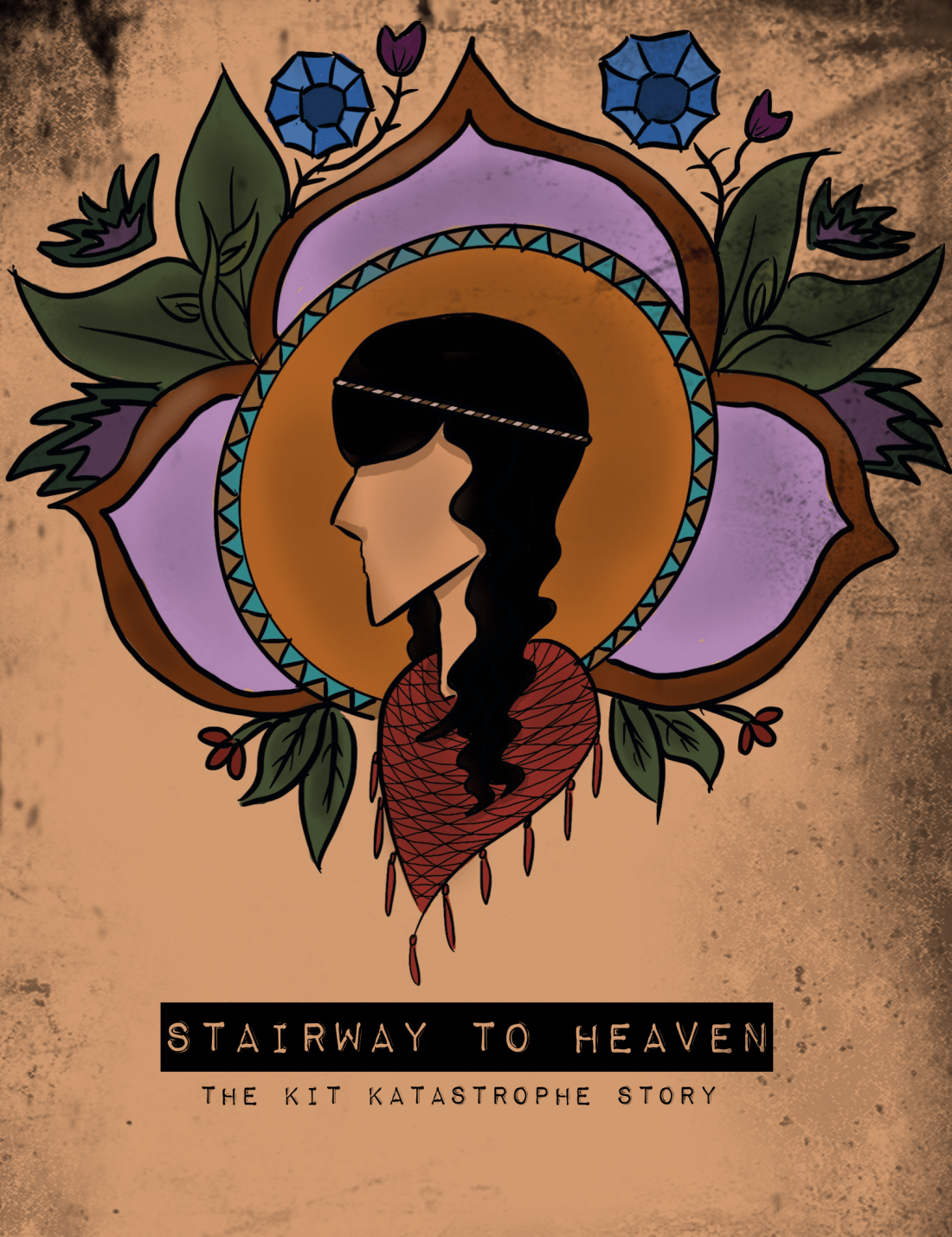
This is a prequel to the series, The Downriver Kids, focusing on Kit’s backstory.
Huge content warning here, this story deals with self-harm, suicidal thoughts, mental health issues, and sexual assault. If these things are sensitive topics for you, don’t feel obligated to read tbis! The rest of the TDK storyline will still make sense without the information here. Consider this a standalone story that gives just a little more detail on Kit’s background.
“Astaghfirullah.” Forgive me, God.
My skin goes numb as I whisper it to myself. I glance around the chemistry lab. These are the kids I grew up with. Every one of them is a stranger.
Everybody knows.
The thermometer by the door tells me the room is 73 degrees Fahrenheit. That’s a lie. It is an arctic hellhole, and I feel as if my entire body is a moment away from falling into hypothermic shock. My organs will readily shut down if I stay any longer.
They are talking about you. Every single one.
My mind screams at me in many languages, some I don’t even understand. I try to silence them by focusing on the worksheet in front of me. The letters are incomprehensible to me and link together to form entirely nonsensical statements. “What is the weight of .30 mol of oxygen?” “Where is oxygen?” “Did you put a mole in the oxygen bathtub?” “Did you forget to ask the chocolate shake society about the hammock in the freezer?”
Everything is nonsensical. My body wretches with thoughts of memories I no longer wish to have, and the atmosphere is loud, louder than the bombs from my mother’s separate, no less traumatic memories. Louder than the screeching, piercing sound my amplifier made when I first plugged it in. Louder than my family’s cafe at peak time or the local shows I’d sneak into when I was supposed to be at football games.
Everybody knows. They look at me with disgust and disdain. Everybody knows.
I can’t be here. I can’t. I can’t.
I don’t bother to grab any of my belongings off the table. I throw down my pencil and run out of the room, ignoring my teacher’s pleas.
“Mr. Hachem!” I hear him say as I slam the classroom door behind me. “Khaled! Is something–”
I couldn’t make out the rest of his sentence, not with the chaos in my head. I’m almost in tears as I find my older brother’s class. I barely see his greasy, spike-haired head look up as I scream through the window.
“Ali! I have to go home!”
His class goes silent.
“What? Kit?”
“I’m going home! Tell Mom I love her!”
I hear his chair crash into the linoleum and the door flies open with the force of a hurricane. My brother is much larger and stronger than me, but I can outrun him easily.
In what seems like just a few seconds, I’m halfway down the street, with Edsel Ford High miles and miles behind me. A memory. A very distant, very unpleasant memory.
They’re coming for you. All of them. You need to leave.
At once I feel sick and dirty and torn and scared, overwhelmed with emotions I’d always been able to suppress to some extent. Now, the floodgates have opened. My heels dig into the cold, wet ground as the rain catches in my hair. I whisper prayers and proverbs my parents taught me to no avail. God closed his eyes and the weight of the world fell onto me. I feel it more than ever.
Astaghfirullah, I say again, under my breath.
I no longer wish to be alive.
My home feels like a forbidden castle. My hand touches the doorknob and electricity flows. My parents are downstairs, managing the cafe, unaware of my steps as I ascend the stairs to our apartment. Breathing deep, I fall onto the carpet, clawing fruitlessly at the threads, trying to force myself onto my feet. Strength is a commodity I cannot find. All around the home are works of art and keepsakes from my family’s homeland. I feel unattached, as if every trace of my DNA rewrote itself into a crossword puzzle too convoluted to decipher. I have no history, no name, no identity. I no longer feel human.
The voices grow louder as I reach the door to my parents’ room. I shed my hoodie and jeans and set a bath. The unclothed person in the mirror is a stranger, emaciated with sunken features. My once-bronze skin has become a sickly, alien pale, and my dark, unkempt hair is thrown into a half-assed braid. Fresh, healing wounds line my inner arms and occur in small bursts along my frail body like macabre tattoos. I don’t like the image I see looking back at me.
Water rushes and gurgles. It becomes the soundtrack to my prayers. I fall onto the lush rug and press my face into the ground. It takes everything in me not to claw my own hair out. The bathroom is loud and frightening. I curl up for a moment, hugging my legs to my chest, and whisper one final time.
”Astaghfirullah.” Forgive me, God.
Cautiously, I step into the bathtub and sink into the warmth of the water. Breathing deep, I reach for the tiny sliver of metal I learned to hide so discreetly under my mother’s candle. I press the edge against the inside of my arm, carefully, watching little lines of red flow and dissipate. Holding my breath, I press it deeper into my skin. Deeper and deeper, tearing new fissures in my flesh. The sting is familiar, but this time, it’s final. The water in the bathtub begins to overflow, spilling out onto the floor. I close my eyes and fall into unconsciousness.
As I slip away, I hear the front door creak open, followed by my mother’s voice. “Kit? Ali said you went home early. Are you okay?”
Her steps continue up the stairs. All is blurry, but I can make out her familiar silhouette appearing in the doorway to the master bedroom. It’s the last thing I see.
”Khaled! Habibi!”
—
I don’t know what I expected when I finally transferred to Triumph Academy. The halls lack the heavy air that comes with unwanted memories, but the voices haven’t died down much. The pills don’t do much either. I take them each morning, divvying them up the way my brothers and I would split M&Ms during our younger years. Here was a blue one, here was a green one. Part of me is convinced my psych actually replaced my meds with M&Ms and that’s why they haven’t been working, but I’m afraid to bite into them. I fear I’ll find a chocolatey center and know that the last few months have all been a lie.
I’m not a stranger to the special education room. When I was little, the doctor diagnosed me with a bunch of words my mom couldn’t pronounce. I remember being in the office and sneaking away from the watch of my parents, back to the antique grand piano in the waiting room. I hadn’t said a word during the entire appointment, but as I pieced together individual notes into chords, not having the slightest idea what any of that meant, I said all I needed to say. That night, my dad found my grandfather’s oud — a Middle Eastern lute, the ancestor to the modern guitar — in the attic and gave it to me. When I played, the voices were quiet, and I could say everything I couldn’t articulate. Even after learning to speak fluent English, Arabic, and French, music was my first and favorite language.
The teacher doesn’t attend to me much. I’m not here because I need help with any of my work. That’s not why I’m here. I’m here because I take a handful of M&M pills everyday just to function. I’m here because I’m crazy.
A small, pink-haired girl sits down beside me, tossing her patched-up corduroy backpack onto the table. She locks eyes with me, and I immediately focus back on the math worksheet in front of me.
She’s going to speak to me. Oh god, she is going to speak to–
“Hey, you.”
Shit.
“What’s your name? I’m Tessa.”
I continue to stare blankly at the numbers on the page. I feel her stare burning into the side of my head. Perhaps if I ignore it, it will go away. Perhaps—
“I like your hair,” the pink-haired girl chirps. “You don’t say much, do you?”
I am not dealing with this. I consider moving to another table, but I’m practically cornered. Leaning back into the wall, I glance at the patches on her backpack. Several bands, mostly older ones, names I recognized from the old vinyls my dad passed on to me. One in particular caught my eye.
“You like Led Zeppelin?” I utter, halfway hoping she didn’t hear me.
“Yeah,” she says, her deep blue eyes looking up toward me. “How did you know?”
I smirk. “It’s on your backpack.”
She starts fidgeting with the threads on the backpack. Tessa appears a bit younger than me, with a sickening amount of energy and optimism. She’s wearing a t-shirt with the KISS logo emblazoned on the front and ripped up jeans. She wiggled her leg incessantly, shaking the entire table. Her existence is infuriating, but something about her presence is comforting.
“I’m Kit,” I say. “And Led Zeppelin is probably my favorite band.”
“I’m a little more Beatles,” she says. “Why are you in here?”
I don’t know how to respond to this.
“Like I have ADHD,” she says. “You know, so they put me in here for an hour each day. What are you doing in the ‘sped’ room?”
I tried to sound out the word my mom stumbled over. “Skit-so-fran-ya?” I manage to spit out. “I don’t know how to say it very well. My mom can’t even pronounce it, but English isn’t her first language.”
She backs away somewhat, squinting her eyes at me. “Are you…my parents told me not to talk to you people.”
“With skit-so—schizophrenia people?”
Her eyes become little angry slits. “No.” Her voice gets deep and raspy, as if she’s imitating someone. “Damn dirty Ay-rabs. They like to charm pretty white girls into marrying them so they can make them wear burqas and have a bunch of babies for them.” She grins again. “And probably schizophrenics, too. I don’t know. My parents didn’t say a lot about those. But—” She locks eyes with me again. “—my parents are assholes and you like Led Zeppelin. Let’s be friends.”
—
I haven’t been this happy to be home in a while.
My mom’s making dinner. I pick at the bowl of fattoush she set in front of me and my siblings. My younger brother, Bashar, shares a pack of animal crackers with Miriam, my baby sister, while my oldest brother, Yousef, watches on. Ali and I just got back from football practice, or for me, bench-sitting practice. The coaches do their best to keep me on the sidelines, and I did whatever I could to help them keep me there. I never wanted to be an athlete. It was just something that was expected of me.
My father sits down beside me, still wearing his work apron. He was the family cafe’s chef, although he’d be the first to admit my mother was the brains of the operation. “Habibi,” he begins as he brushes my bangs out of my face, “please tell me you’ve been feeling better. You know you worried me sick.”
“Baba, I’m better now,” I say, forcing a smile. “The medications are working.” This is a lie, but I don’t want him to stress over me. He has enough to worry about as it is.
My mom brings out several plates, beaming with pride. Everyone in our family says I most resemble her, far more than any of my other siblings. We share the same willowy build, the same eyes, the same long, thick, curly hair, although hers is usually tied up in a bun and loosely wrapped in a headscarf. My dad says I look almost exactly like she did back when she was young, which is somewhat disconcerting, since I am for all intents and purposes male, but I’m sure he means it as a compliment. After all, she’s arguably the most beautiful person I know.
We start piling food onto our plates and my mom asks, “How was everyone’s first day?”
Ali is first to pipe up. “It sucked. I still don’t get why we had to transfer. I wanna go back to Edsel Ford. At least their football team doesn’t suck.”
“Don’t be an asshole, Ali,” Yousef scolded him. “It’s not all about you.”
My mom shushes them. “We had to do what’s best for your brother, and he wasn’t thriving there. You saw what happened.”
I pull my hoodie over my head and slouch a bit lower in my chair. I hate feeling like I’m a burden to them.
Ali’s voice is rough. “‘What happened?’ So I could slit my wrists and get what anything I want?”
My father swears in his native tongue and slams his fist down on the dining table, rattling all of our plates. “Your brother is sick! Have some respect.”
I feel the tension in the air, almost as heavy as the atmosphere back at the halls of Edsel Ford. Ali lowers his head. I know he regrets his outburst, but it doesn’t make a damn thing better for me. I leave the table, having barely touched my food, and excuse myself to my bedroom.
The voices come back. They tell me I’m a burden, that I should have driven the blade deeper the first time, that my family would be better off without me. I bury my face into the pillow, trying to silence them, but here, face down on my quilt, they seem so real to me. I go back to the halls of Edsel, to muffled conversations in the locker room. The words are so clear to me now.
Why is he even on the team? He doesn’t do shit.
He’d make a hot chick. I’d hit it.
What a fucking faggot.
He’s only on the team because his brother’s the captain.
He should kill himself.
The last one cut the deepest, and it keeps repeating and repeating in my head until it’s louder than my family’s tense dinner conversation and the sound of the radio I left on earlier. I peel myself from the bed and start to thumb through my record collection. Zeppelin, old blues vinyls, Kinks, Clapton, Beatles, Johnny Cash…
I recall the conversation I had with Tessa, that strange, odd creature, and how she offhandedly mentioned that she liked the Beatles. I hadn’t listened to them much, but something compels me to pick up the album titled Let It Be. I drop the needle at a random spot and lie flat on the floor, folding my hands on my chest, imagining I’m listening to my own dirge. I wonder if Tessa has even spent a second thinking about me. The idea of having friends — no, a friend — is unfamiliar and foreign. She’ll forget I exist, I decide as I begin to fall asleep on the cold hardwood floor.
—
Tessa hasn’t forgotten about me.
“Why do you find me interesting?” I ask her. School just let out, and she says she’s taking me to a “secret place,” which may or may not lead to my death, which may or may not be a welcome thing.
She shrugs. “I dunno. You’re a lot more interesting than I am.”
We’re walking through a suburban neighborhood, your stereotypical brick house farm. The first couple of blocks were a middle-class haven of SUVs and garden gnomes, but the further we go down the road, the less pleasant the area. Boarded up homes with graffiti are abundant. She holds onto my arm, and I immediately shake it off. After all, she’s the one who led me here. If anyone is going to be afraid, it sure as hell shouldn’t be her.
“This is the creepiest part,” she says, hiding her nervousness behind a facade of confidence. She sounds like a tour guide. “If you’re going to be going to be exploring abandoned houses, you have to look for ones that don’t seem like they have any squatters in them, and you have to find a way to get in without damaging the building. That’s the first rule of urban exploration.”
I stop and glare at her. “Wait, what did you say?”
“The first rule is don’t do any damage,” she says. “What do you think we are, hooligans?”
“Tessa,” I begin, in all seriousness. “Are we in Detroit?”
She laughs. “It’s all semantics.”
“Tessa,” I repeat. “Are we in Detroit?”
“Technically yeah, but like I said—”
“You’re going to get us killed!”
She opens up her denim backpack and grabs two cans of Arnold Palmer. “Someone needs to learn to live a little. Come on, this is the fun part!”
She runs into a neglected yard full of weeds and trash and begins inspecting the perimeter of the house. I see her pile up a few stray bricks into a makeshift step-stool. She peers into the window and gives me an enthusiastic thumbs up.
“Just so you know, I totally lied!” she yells to me. “The first rule is make sure no one lives there!”
We find a pre-existing opening — the back window was already broken open. She’s first to crawl in, giving the interior a quick look to make sure all is safe and structurally stable. I take it that’s a skill you pick up after breaking into houses a number of times. She gives me the okay, and I climb through the open window, tumbling over an old-fashioned radiator and landing face-first on the living room floor. I brush off the mystery dirt — where the hell does the dust in an abandoned home come from anyways? — and follow Tessa into the kitchen.
She opens the refrigerator and pulls out the most nauseating jug of milk I’ve ever laid eyes on, inspecting it thoroughly for reasons I’d rather not know.
“Kit! Look, it expired last year!” She offers it to me. “Wanna sniff?”
“God no!” I yell, nearly passing out from just the sight.
She shakes the jug, making the contents jiggle horrifically. “Wiggle wiggle wiggle,” she sings.
This girl is literally insane. I may actually die here.
Upstairs, we find an old waterbed. She flops onto it like a dead fish, and I sit down beside her, still mystified by her infinite strangeness.
“See? Look at all the cool stuff you find!” She flails her arms and legs, making the bed practically impossible to sit comfortably on. I crash down into the bed. We stare at the hideous popcorn ceiling for a good minute, letting the smoggy city air flow over us through the open window. It’s starting to get dusky and I’d rather not be in Detroit after dark, but I’m afraid I’m at the mercy of Tessa. I’ve never met anyone crazier than her, not even at the loony bin I got dumped in.
Still, we talk and talk and stare at the hideous ceiling until nothing feels real anymore.
“Where are you from?” she asks me at one point.
“Lebanon,” I say. “Well, my family is at least. My dad, my siblings and I were all born here, though.”
She kicks her leg against the waterbed, making the entire earth shake below us. “Lebanon? I don’t even know where that is. Why did your family come here?”
I sighed. “They just didn’t feel safe anymore.” I recalled the way my mother teared up remembering the sound of the bombs. “My parents always told me you don’t know pain until you watch your home get destroyed.”
“I know a little how it feels,” she says. “Not like, bombs, but losing your house. I wasn’t going to say anything, but do you know where you are, right now?”
“Detroit?”
“This is my childhood home,” she says with the kind of jadedness you rarely hear from someone as young as her. “This is my old bed. We lost our home after my dad lost his job.”
Everything feels surreal. The sun starts to paint twisted shapes onto the far wall. I wonder how many times she’s watched the sun set from this bed. I wonder how many memories were formed here. I wonder how much of this place remains with her.
“This isn’t the only house like this. There are lots more around,” she says. “That’s why I like doing what I do. Everyone has a story, and every place has a story. I just like to see what people leave behind.”
I turn to her. “I’m glad I met you.”
She grins. “Same.”
At home, in my own room, I throw off my hoodie and grab my acoustic guitar. Strumming it lightly, I find myself mumbling along to an old Beatles melody.
“I wanna hold your hand,” I catch myself singing. “I wanna hold your hand.”
—
Nights are never easy. I find myself in the cot assigned to me back at the psych ward, sleeping next to a stranger whose name I vaguely remember as being Kyle. Or was it Colin? I think it was Kyle. I hear the tortured moans of all the people who were here long before I was, and will remain long after I leave. At least I have a chance to live in mainstream society. My heart broke for the poor guy next to me, whose illness was so severe, he’d never be able to live a life without constant care.
My first week there was the most difficult, and it’s what I remember most clearly.
“Hachem,” a voice says. “Khaled Hachem?”
I raise my hand meekly. My parents are on either side of me. My mom drapes her arm around me as I’m led to a back room. My mom and dad draw me in for one last embrace, hoping that the next time they see me, they’ll be taking home a slightly more stable son. I’m left alone with nothing but my thoughts, fears, and complete strangers.
They take me to an isolated room and ask me to take off my clothes. Begrudgingly, I oblige, but only after they leave. They want blood and urine samples. The latter is easy enough. Then, I feel the sting of a needle in my inner arm, inches away from the now-healing self-inflicted gash. I wince, remembering how it got there in the first place. That’s why I’m here, right? So I can stop carving myself like the world’s most miserable jack-o-lantern.
The voices are full force, uttering nonsense at me, something about beach volleyball and lamb chops. I can’t make heads or tails of it.
They need to check for vitals now. I’m still half-naked and vulnerable. I wonder if they’re sizing up my scars, comparing them to the ones they’d seen before. I wonder if they ever make a game out of finding the nut with the most scars. I wonder where I rank.
Don’t let them near you.
The nurse speaks to me softly, asking me irrelevant questions about what grade I’m in and where I’m from (I still get that a lot) and what I like to do for fun. I know this is part of her job, making me feel comfortable, but I’m shivering, both from cold and fear, and she can see it. The voices come strong.
This is bad. Run. Get up and run. Bad. Bad. Bad—
She listens to my heartbeat. I close my eyes and try to think of something, anything but this. She says something about medications, but I can’t hear anything. Now her hands are on my skin, asking with each prod whether something hurts. She feels around my ribs, my belly, lower, lower…
Bad!
I don’t know exactly what happened, but I hear the nurse shriek and call for help. I keep saying sorry, over and over, not even sure what I’ve done. I’m no longer lying down, but curled up, holding my legs tightly to my chest.
“He…he bit me,” the nurse says. “The patient bit me.”
Everything is loud. I don’t know what’s going on. I’m screaming and crying and panicking. A moment later, and my arms and legs are seemingly tied down. I pull against the restraints, helpless and agonized, thrashing until I’m out of breath, and another needle slides into my vein.
I wake up, back in my own bed, in my own room. My sweat has soaked through my bedsheets. It’s only three in the morning. Everything is where I left it. The comforting presence of Robert Plant and Jimmy Page look down from my wall. Half-empty Dr. Pepper bottles are scattered on the floor. I pull the quilt tight around me, observing the little bit of light leaking into the room under the door.
The memories continue to flood back. This time, I find myself back at my old school, in the gym. Football practice, or the time immediately after. I’m alone on the bleachers. My brother is off somewhere, packing up. A couple of the guys said they’d wanted to hang out after practice. Until then, no one gave me the time of day. They told me to wait, so I did.
I now know exactly what was going to happen next. I want to scream at my former self. My skin crawls. I tear at the sheets. My hand slips beneath my mattress, to a bottle of pills I didn’t want to need.
Nothing is real.
Everything is real.
—
“See, I take pictures, and I post them online.”
Tessa stands atop a counter, twisting and ducking with her camera, trying to get the perfect shot of the trash on a kitchen floor. This is just what we do now, I guess. I can’t complain. She is a human and she likes me, for some reason. Best of all, she actually exists. That’s not something I take for granted lately.
“There are other people who are into this?” I ask.
“Oh, lots,” she says, snapping a few more before jumping down. “Entire forums for urbex stuff. That’s what the internet is for. Finding more people who are weird like you.” She hoists herself onto the dishwasher. “What about you, Kit? What do you do?”
“What?”
“What’s your thing?”
“Guitar,” I say. “I play guitar.”
“Oh yeah? Are you in a band?”
“Nah. Would like to be someday, though.” I glance out the open window we snuck through. “But I’m much too shy for that kind of thing.”
I watch her try to climb onto the refrigerator, to no avail. “You don’t know that,” she says. “You might be a natural. My dad plays drums. You should come jam with him, just to get a feel for it.”
“Will your parents even like me?” I ask. “I thought they didn’t like…”
“It’s okay,” she says. “I’ll just tell them you’re Italian or something. Besides, it’s not like you’re my boyfriend or anything.”
“Oh, god no. Not at all.”
“We’re too young for that shit.”
“I don’t even like girls.”
Tessa whips her head up with wide eyes. “You’re…you’re…”
“I mean, I don’t like guys either,” I say. “I’m just not into anything.”
She smiles. “Hey, nothing wrong with that.”
Tessa lives in a trailer in the next town over. It’s a quaint little place, better than I would have expected from a somewhat dumpy trailer park. She leads me through the door — there’s a hand-carved sign that reads “The Harlows” with stick figures of each family member. Inside, she leads me around, adopting her stately tour-guide tone, showing off the collections of items in her house with the amount of pride typically reserved for freshly unearthed ancient artifacts. Everything here has a story, and if it doesn’t, she finds a way to give it one.
“My mom collects these little statues,” she says, waving her hand in front of a line of pastel-painted cherub figurines. “She thinks they’re cute. I think they’re creepy. And here’s a pair of drumsticks my dad got from the guy in Rush back in the 70s. These are the realistic birds my grandma used to collect back when she was alive. Now, we take a few to the cemetery every couple months and bring the old ones back here.” She holds up one of faded grave-birds. “And here’s a picture of my brother when he played with the marching band in Warshington.”
“‘Warshington?'” I repeat back to her. I use it as an opportunity to ask the question I’m so used to hearing myself. “Where are you from?”
She turns red. “Sorry, I’m so used to hearing my dad pronounce it that way. We’re from down south, Kentucky specifically. I was born here, but e’ry now and then–” She puts on an exaggerated Southern accent. “—mah roots come out.”
A certain picture catches my eye. A girl — Tessa? — is standing in an elaborately decorated hall, wearing what looks like a wedding dress and a rejected costume from the Swan Lake ballet had a love child. It looks relatively recent.
“Is that you?” I ask.
She rolls her eyes. “Unfortunately. That was last year, at the purity ball.”
“What the hell is a purity ball?”
“Oh, it’s just this ceremony where little girls promise their dads that they’re not gonna go out and bang anybody before marriage,” she says. “It’s like a bat mitzvah for creepy people.”
“Is that a Kentucky thing?”
“Not at all. It’s because after my grandma died, my parents got all weirdly religious. They weren’t like that before.” She turns the picture around so I can no longer see it. “I don’t even get the point of the whole ‘purity ball’ thing. Most of the girls there weren’t even old enough to know what sex is. I’m still not entirely sure how that thing works.”
Tessa’s mom comes into the living room. I’m overwhelmed by the smell of some kind of perfume.
“Oh, you must be Tessie’s new friend,” she says, wrapping her arms around me, getting her suburban-mom-stink all over my flannel. “I’m Sherry, Tessa’s mom.”
I pull away from her grip. “I’m Kit. I like your…uh…” I look around the room for something, anything. “…statues. The angel ones.”
She sighs. “I just love these little guys. Here.” She holds up one riding a heavenly motorcycle painted in colors resembling floral barf. “You can have this one. From me to you.”
It’s hard to force a smile, but I manage. “Thanks.”
Dinner is a nightmare — ham, biscuits with gravy, and greasy green beans littered with bits of bacon. I consider filling my plate with nothing but mashed potatoes, the only halal, or permitted, option on the table, but I don’t want to seem like an ungrateful asshole in front of these people I just met. Reluctantly, I slice off a piece of ham from the pink slab in front of me.
“So where are you from?” Sherry asks.
That question again.
Before I have a chance to answer, Tessa chimes in. “Italy. He’s from Italy.”
Her father, whose name I learned is Jim, takes a bite of his ham. “That’s far away. What brings you here?”
I slice a cube of the forbidden meat and stab it with my fork, hesitating. “A lot of things.” I decide to change the subject before they ask any more questions. “Tessa says you play drums.” I take a bite of the ham, and something on my face must have given away the fact that this was new to me. The family collectively stares at me as I struggle to swallow the bite. Every second of this dinner is humiliating. “I…play…guitar.” I spit out between coughs.
“Tessie was telling me,” Jim says. “You looking to play with other musicians? Because the youth praise team at our church is looking for new members. Do you go anywhere now?”
Already sick of the ham, I try the green beans, which are surprisingly not terrible, although I feel a bit guilty for just thinking that. “I go to a lot of places. Uh, school, football practice, um…”
“I mean, does your family go to any church? I’m assuming since you’re Italian, you’re probably Catholic.”
I am not at all ready for this. “Yes, yes, very much Catholic,” I manage, and imitate the cross-yourself motion I’ve seen people do on TV, hoping they don’t notice that I really have no idea what I’m doing.
Thankfully, Tessa’s older brother, Brenden, changes the subject, ranting about some girl in the marching band who won’t give him the time of day. Tessa and I stare at each other, and she rolls her eyes.
I don’t know how to feel about Brenden. He strikes me as a bitter person, especially as he talks about this girl. Freshman year flute player named Amy. I guess they’ve been friends for a while, and he doesn’t seem to grasp that she’s not interested in much more. I didn’t pay any of his ranting much mind until one statement caught my attention.
“Last I heard she was going to homecoming with some Ay-rab kid,” he says. “Fucking assholes, coming in and taking all the good girls.”
Jim slams his fork into his mashed potatoes and stares him down. “We don’t talk like that at the dinner table.”
—
“You’ve sure made quite a bit of progress, Mr. Hachem,” the counselor says, scanning over my records. “You should be ready to be discharged soon.”
The stay in the psychiatric ward became increasingly bearable as the weeks went by. I don’t know if I’ve actually gotten any better or if it’s just the meds numbing the right parts of my brain. The voices don’t scream as loud. They’re still there, but hushed, and not as menacing. They’ve gone from paranoid at best and threatening at worst to mostly nonsensical babbling.
The ward itself is not as “One Flew Over the Cuckoo’s Nest” as I imagined it. If you don’t count all the locked doors and security measures, it’s actually kind of homey. I might miss it here once I leave. The schedules are rigid. Wake up, breakfast and morning meds, free time, lunch and afternoon meds, counseling, visitation, dinner and evening meds, and for the last couple of waking hours, they put on movies. Usually, during movie time, I’d go to the piano in the common room to work on compositions. I’ve played a few of my pieces for the psychologist, who’s been encouraging it as part of my therapy. I’ve also given miniature recitals for the nurses and other patients. Some guy keeps calling me Beethoven and trying to touch my hair. I hate it.
It’s a youth ward, so the other patients are somewhat close to my age. Many are suicidal or anorexic. My roommate, Kyle/Colin, is also a paranoid schizophrenic, but his symptoms are far more severe than mine, to the point where he almost never leaves the room. My mother always taught me to be thankful, and Kyle/Colin’s incessant, incomprehensible strings of words just remind me of how much worse of a hand I could have gotten. Still, I’d trade him any day. He seems just detached enough from reality to be somewhat happy. I have one eye in the real world, and at times I was it were blind.
After my initial outburst on the first day, the doctors put me on Xanax, which has calmed me down considerably. Even after I ran out, I managed to convince Kyle/Colin to lend me his. Questionable, yes, but at this point, I need to do what I can to feel stable.
Therapy resumes. I’m one of several teenagers here slapped with the suicidal tendencies label. A girl named Kaitlyn sits next to me, her arms bearing a number of scars she passed off as cat scratches for years. To my right is Liam, whose parents caught him not a minute too late, noose in hand.
“Who would like to begin?” the counselor asks, notepad in hand.
Kaitlyn raises her hand. “I’ve been really anxious lately. I don’t even know why.”
The counselor scribbles something on the pages in his notebook. “How long have you been feeling like this, Kaitlyn?”
“A while,” she says. “I was starting to feel a lot better, my medicine was working, I thought I was out of the woods. Then I remembered the last time I was in here and how I had the same thought. And I probably will again.” There’s a silence. “I’m afraid of the…the…what is the word? The relapse, I guess. I don’t know if the next time will be worse.”
She’s been here before. A lot of these kids have been here before, it seems. I bite my lip out of nervousness.
“Kaitlyn,” the counselor says, “you realize you do have a mental illness. And there is no cure for that. You’ll always have scares like this unless science can come up with a more permanent solution. But as long as you take your medication and keep up with your therapy, you will have a much better chance of suppressing your symptoms.”
“I just wish there was a way to be normal,” she says.
The otherwise stoic counselor cracks a small smile. “There’s no such thing as normal people. And if there are, I don’t want to be friends with them.”
—
I’ve been playing with Jim’s worship team for a few weeks now. The church is a completely different world from what I’m used to. Not like I ever felt like I fit in at my family’s mosque, either, but even while I’m on stage, in my element and entirely removed from everyone and everything around me, I feel uneasy.
My one refuge is Tessa. Sometimes as I play, I’ll look into the congregation (or perhaps more appropriately, audience) and see her staring up at me, Kool-Aid pink hair aglow in the dark. I’ve also grown somewhat close to the keyboardist, a slightly older girl named Sarah, who also happens to be the only person besides Tessa who knows the truth about my religious orientation. One day, after Sunday service, she came up to me while we were packing up our gear.
“Kit, I’ve noticed you don’t close your eyes during prayer,” she said. “Is something wrong?”
I whispered to her, making sure no one was within earshot. “To be honest, I’m not actually Christian at all. My family, I mean, we follow Islam.”
She looked confused, though not at all apprehensive. “So you’re Muslim?”
As I stowed my guitar in its case, my sleeve rolled down slightly, revealing a set of neatly drawn scars. “To be honest, I’m not sure I believe in anything anymore.”
Her eyes softened. “I still wouldn’t care about you any less.”
—
School doesn’t get easier, but it’s become so routine, I’ve hardly even noticed it happening to me. My brother hasn’t made things better, and to be honest, it’s painful to hear Ali talk about the incident as if everything was alright now. It comes up at football practice now and then, basically whenever anyone asks why I’m on the team at all. I’m his responsibility, and even if I was a skilled athlete, my calling card would still be “the crazy one who tried to kill himself.”
Since the start of the new school year, Ali had moved up in status on the team, becoming the new favorite among all five people who actually care about Triumph’s athletic program. I’d be the first to admit I do feel like a bit of a black sheep. Even my father played while he lived in Detroit in his youth. That was one of the things that helped him connect to American culture as the child of immigrants and feel more at home. In fact, once he moved to Lebanon for college, one of the few things he missed about the U.S. was the prevalence of football.
There is one member of the team aside from my brother I have talked to. His name’s Alex, and it was only in passing, but I guess he just switched schools as well. He’s a musician too, and he left a band behind in his old city. I was going to ask him if he wanted to collaborate, but I’m sure he has much better things to do than associate with the token suicidal maniac.
Although something did happen that gave me a brief, fleeting sense of hope. Before practice, I saw him and another kid posting flyers around the outside of the school. I couldn’t read the small print at first, but I managed to piece together the message on the tacky lime green paper. He was looking for a guitarist for a new project, it seemed. As I passed him by on the way to change into my practice clothes, he stopped me.
“Kit, right?” He hands me a sheet from the stack of flyers. “Ali was telling me you’re a guitarist. If you’re not busy next week, you should try out for this.”
—
“Should I try out for this?”
I hand Tessa the ugly green flyer from earlier. She looks at it and squints.
“Ew, they look like a bunch of crappy Blink-182 wannabes. I say go for it.”
Our legs dangle out the window of a large abandoned building in Detroit, the Michigan Central Station, which Tessa tells me is the Holy Grail of urban exploration in Michigan. She’s been wanting to come up here for a while, but never felt comfortable going to the sketchier parts of Detroit alone, as plucky as she is. She’s kept a tiny pink can of pepper spray in her hand during the entire adventure, but so far, nothing too alarming has happened. A homeless guy approached us and asked for cash, and being the broke kids we are, we didn’t have much to contribute, but I gave him half of the Nutella-and-banana sandwich Tessa made me before we left. Tessa gave him the plush Pikachu keychain from her backpack. She said if she was in that situation, she’d want a cute thing to keep her company.
The sun is starting to descend behind the Detroit skyline. We watch the birds from our concrete perch, and I pick pieces of bread from the remainder of my sandwich to throw to them. Tessa’s rambling about video games and her love affair with those dollar cans of tea from the gas station and all the abandoned places she wants to break into. At one point, she lays her head on my shoulder, which startles me at first. I think she noticed me squirm, as she looked at me sorta hurt that I moved away, and I immediately feel guilty that my knee-jerk reaction to physical affection offended her. I wrap my arm around her and a shock of pink hair falls onto my chest.
She sighs. “To be honest, you’re the only person I’ve ever been able to call a friend,” she says. “I feel like I can talk to you about anything.”
God, I wish I could say the same.
—
I don’t know much about how my family was before I was born, but I can safely assume Ali and Yousef were a much different situation from me. I can’t fault my mother and father for freaking out when I didn’t merrily skip through the earliest stages of life quite as easily as my brothers.
My earliest memory, for example, was the sadness in my mother’s voice.
“Habibi,” she said, “why won’t you look at Mommy?”
I didn’t talk until I was four, not a single word. Autism was a word that was being thrown around somewhat, I remember, and I don’t think the doctors entirely ruled out that possibility. All that was known at the time was that whatever was going on inside my head was not normal.
My mother held me against her breast in the waiting room. I felt her breathing deeply, watching as my brothers played with the toy train in the corner. It was a children’s clinic, with toys scattered about and coloring books at a tiny table. There were magazines for parents, mostly celebrity gossip and fashion mags, all things my mother rarely concerned herself with. In the corner was a dusty Steinway, which hadn’t been touched in years it seemed.
Finally, a nurse appeared, beckoning my mother and I.
We followed her into the back, Ali and Yousef in tow. They did the usual stuff, taking my temperature and weight. Then we went to a small room, and I sat at my mother’s side as she answered a bunch of questions full of words I didn’t understand. I don’t remember how it happened, but my mother said at one point, I’d slipped out of the room without her or the nurse noticing. I guess the staff searched the halls fruitlessly until one of the nurses heard the Steinway in the waiting room. They found me at the old piano, pressing down the keys and finding notes that sounded pleasant together, complete harmonies. My mother was about to scold me until the nurse she’d been talking to stopped her.
“He has more to say than you think,” the nurse said.
—
Ali was the one who gave me my nickname. He couldn’t pronounce my real first name, Khaled, as a three year old. At first, my parents objected to the name, but my dad eventually caved and started calling me Kit as well. He said it made sense. I was quiet yet intelligent, not unlike a fox kit.
The third person to call me by that name was a little girl who was, for all intents and purposes, my first friend. We met on a playground when I was barely old enough to walk, and just barely able to speak. My brothers were on top of the jungle gym, seeing who could spit farther. I was alone in the sandbox, tracing shapes in the sand as my mom looked on. Uninvited, a blonde girl in purple overalls ambled into the sandbox, dropping a pair of dinosaur figures onto my sand-drawings.
“Hi, I’m Stephanie!” she said with a huge grin. “What’s your name?”
“K-Kit,” I uttered without looking up.
“Hi Kit!” she sang. “Let’s play dinos! I’ll be triceratops and you be t-rex. That one’s my favorite.”
We stayed in the sandbox for what felt to me like hours. We built a giant dinosaur castle and had our figurines fight the invisible enemies she made up and at one point we pretended the dinosaurs built a rocket ship and went to space and in that time, I felt for the first time something resembling happiness. I wish I could say Stephanie and I became friends, but really, it was nothing more than a single afternoon of foolish, childish adventures cut short by something I couldn’t comprehend at the time. At one point, her mother came over and saw my mom, draped in her maroon scarf. At once, she pulled Stephanie from the sandbox. I stared dumbfounded, t-rex figure still in hand, as they started walking toward the parking lot.
“Stephanie,” the mother said, “you know we don’t hang out with those people.”
I tell this story to my therapist during my stay at the psych ward. She taps her pen against the clipboard, a sound that has become familiar to me.
“From what you’ve told me, you haven’t had the easiest time making friends,” she says. “How were things as you got older?”
“Not a lot better,” I say. “I mean, my brothers had a lot of similar experiences like that — and it got even worse after 9/11 happened. My mother got called all kinds of nasty things, so much that she stopped wearing her scarf for a few years, and our restaurant got vandalized once. That’s part of the reason my brothers and I adopted ‘English’ names. My dad got really scared for everyone’s safety. It’s just…when you’re so little and dealing with all of that, and then meanwhile, your brain is fighting you from the inside.”
She scribbles something down. “You’re right. You were very young when you started experiencing mental issues, and having the added pressure of the outside world and worrying about your family and not fitting in, you know? I understand why you feel so alone.”
I’ve lost track of the time I spent in the psych ward. The wounds still seem fresh — or have I been making new ones this entire time without realizing it? My inner arm is tender to the touch, and I try to keep the markings hidden from everyone else in the ward. It seems pointless. Everyone here is wounded. Isn’t that why we’re all here?
—
Tessa, Sarah, Brenden, and a few of their church friends are going to some amusement park in Ohio, a few hours away, and Tessa invited me to come along. We’re all in Sarah’s mom van, with Tessa and me sitting in the trunk. We’re younger than everyone else in the van, so we figured it would be best to stay out of everyone’s hair for the most part.
Tessa will not shut up about the roller coasters, especially the one that towers above the rest of the park. I’m biting my nails, hoping she doesn’t drag me on it. So far, it’s not looking too good for me.
“…and it’s the fastest one there, and it’s really tall. Like, REALLY tall. Maybe even taller than that building we climbed. And they tell you that you can’t put your arms up because they might snap off!”
“Well that’s reassuring,” I say.
I don’t like Brenden, and with every passing minute, I dislike Brenden even more. I know it’s not fair to judge him after only being around him twice, but something about him infuriates me. He seems like good friends with Sarah, which means I should probably give him another chance, and he’s Tessa’s brother, which means he’s not leaving my life anytime soon, but that doesn’t mean I have to like him. Right now, he’s talking about this time he and that girl he’s obsessed with were playing Mario Kart and he just knows there’s something there between them and she won’t just accept that he’s her soulmate. I don’t know if it’s him or the car ride, but I swear I need a Dramamine.
We’re taking the back roads to this place, through the wilderness of Ohio, “wilderness” a term I use loosely. The scenery is largely cattle farms and shady liquor stores and at one point, there was a giant nuclear power plant that intrigued Tessa. She said she wants to explore a place like that. She said she might get some kind of superpower. I told her more realistically, she’d probably get radiation poisoning and die. She said that’s a risk she’s totally willing to take, and if she’s right, she won’t let me be her sidekick.
For most of the trip, we just dozed off in the back. Sarah had a playlist of average emo bands playing as a constant backdrop to Brenden’s stupid voice. I don’t know what the other kids’ names are, nor do I actually care. I’ve seen them around on Sundays when I play in the praise team with Sarah, but they’re the ones who yell at the younger members of the church youth group for jacking off, then go out by the dumpsters and have sex.
We left Michigan early enough to make it to the park when the gates open. The place is right on the coast of Lake Erie, a place called Cedar Point, and it’s basically the Disneyland of the Midwest I learned. Despite living here most of my life, I’ve never been to this place. My brothers went a few times with their friends, but I never got an invite.
Tessa has a map of the place with a game plan. We go off on our own and hit the smaller coasters first, since I told her I’d never even been on a coaster and was honestly petrified. She said if I can get used to the easier ones, the huge one at the end wouldn’t be as scary. She didn’t want to concern herself with the little carnival games that dotted the park, since those are for dweebs like her brother who try to win stuff to impress chicks. At some point during the day, we had to meet up with everyone else for dinner.
“This is it?” I say, gazing up toward the monstrosity that is the first coaster Tessa picked. “Are you sure you want to go on this?”
“You know this is the smallest roller coaster in the entire park, right?” she says.
I begrudgingly follow her into the line. Thankfully, we picked a somewhat chilly day to come here, so there aren’t too many people at the park. Tessa passes her time spitting into the water below the platform and watching the fish devour her saliva. She’s admittedly not the classiest person I’ve ever met.
At the front of the line, Tessa fights with me to sit at the very front, a decision I wholeheartedly protest. We make a deal — we don’t have to sit at the front for any of the coasters except the final one, the stupidly huge one she’s obsessed with.
We sit down in this little cart-thing. My bony knees bump into the metal bar, the only thing keeping us from a bloody death. One of the workers comes by to adjust the bar, and Tessa sees me wince as the worker’s hand brushes my leg.
She looks over to me. “You really don’t like being touched, do you?”
The carts start slowly moving toward a small hill. My grip tightens on the bar. Tessa’s not holding on at all, but flailing her arms around and hooting and hollering like a lunatic. I don’t know how she does it, honestly. The cart latches onto a chain, which drags it to the top of the hill. At the top, I realize how small this coaster really is compared to the others in the park, and I feel like even more of an idiot for being afraid. We descend down the hill, and I can barely see anything at all with my own hair whipping in my face. I’m screaming and freaking out as the carts move along the wooden track and I swear the entire thing is going to come crashing down and every one of us will die gruesomely at the bottom of the coaster. We twist and turn and finally reach a point where the carts come to a stop, right before the boarding platform. My head is nothing but a black, knotted mess, which I immediately cover with the hood of my jacket.
“Now wasn’t that fun?” Tessa says with a dumb smile plastered on her face.
At this point, I can’t do anything but laugh.
During the next few waits for progressively larger coasters, Tessa explains the science behind why I have nothing to worry about.
“You see, the reason we don’t fall out of roller coasters is because of the cent-tri-fa…cent-tri-fru…some kind of force.” She skips down the crowded walkway. “And they safety-test this stuff every single day. You have a better chance of dying on the way to Cedar Point.”
“That’s reassuring,” I say.
We walk past a string of carnival games. Most of them offer huge plushes as grand prizes. One stand has a selection of knockoff Stratocasters hanging from the ceiling.
“What if I won one of those for you?” she asks, nudging me.
“Those ones are all cheaply made and really crappy,” I say. “They’re only good guitars for someone who’s never touched a guitar. Still–” I crack a grin. “—I could fix them up, probably. Replace the pickups and the electronics and—”
“I’m gonna win you one,” she says, and races over to the booth.
At least an hour passes. Her eyes are half-glazed over, with nearly every balloon on the board popped. She’s dropped almost every dollar she brought here trying to win a piece of wood disguised as a guitar for me, to the point where she probably could have spent the same amount of money on a real instrument. There’s a pile of stuffed animals at her feet from failed attempts. I’ve been guarding them, since it seems like these prizes are going to be all she has to show for the energy she’s wasted on this dumb game. A couple darts later, a bell rings. Somehow, she managed to hit the grand prize and two seconds later, we’re walking away with a banana yellow Strat.
The sun starts to set as we go out to find Brenden, Sarah, and the others. There’s a noticeable dip in temperature, and I look over to see Tessa shivering. I offer my hoodie, and she throws it on over her t-shirt. I then realized the map of scars on my arms are entirely visible, and I become uneasy at the thought of explaining them to her.
But she’s already noticed them.
“Where did you get those?” she asks.
I don’t want to talk about it with anyone else around, so we go to the edge of the park. The walk is long enough that the anxiety becomes unbearable. How do you explain to your best friend that you’ve tried to kill yourself?
We find ourselves near the edge of the water. She’s still holding onto the guitar and strumming nonsensical chords.
“So a few months ago, I…” I try to catch my breath. “Something really bad happened. Something…I thing I did. These, I mean.” I show her the scars. “I did these.”
“You cut?” Her eyes are big and watery.
“I mean, well, yeah, and worse. I tried to…I wanted to…I wanted to be dead, okay? That’s what happened. I was a fucking wreck.”
She’s actually tearing up a little now. I feel guilty for bringing her into this.
“Why did you do it?” she said with a whimper. “What made you want to do that?”
My hands are shaking. “There are still a lot of things you’ll never know about me. I can’t even explain everything that goes on in my head. That’s the thing nobody tells you about this…this thing I have. I’m afraid of everything. I’ve been hurt in ways I don’t want to talk about. And the voices…there are so many voices and I can’t stop them. They’ve always been there. And for once I just…I just wanted to have control of something, for once.”
—
There’s nothing but darkness. For once, the voices have been silenced. There are blips and mechanical beeps and a weight is holding me down. I open my eyes to find a white ceiling above me. My arms are bloodied and bandaged. My barely-revived body is connected to a machine by several wires, and a needle has been plunged into my hand.
For better or worse, I’m alive.
Ali is in the room with me, looking down with piercing brown eyes.
“Khaled, you have no idea how pissed I am at you,” he says, before his voice turns from a quiet anger to a full-on rage. “What the hell were you thinking, you literal human scum?!”
It takes me a moment to remember how to even use my voice. “This is one way to wake up,” I say.
“Do you think life is some fucking game? Do you realize you were dead?! The doctors had to bring you back to life. You’re lucky you don’t have any brain damage. Although I wouldn’t be surprised if you didn’t have any already, considering you shoved a fucking razorblade in your wrist.”
“What are these?” I rip out the IV and the wires and sit up in the hospital bed. “This isn’t how I imagined the afterlife.”
“Mom hasn’t stopped crying since she found you in the bath,” Ali says, still fuming. “Who do you think you are?”
“I should have bled out,” I say. “Why did you bring me back?”
The sun is bright and painful. A doctor rushes in to find me awake and aware and proceeds to replace the IV despite my protests. My parents walk in after him, eyes red from crying. I hear someone mutter something about the psychiatric ward, and the doctor comes to my side with a syringe.
I cry out again before the doctor succeeds in sedating me. “Why didn’t you just let me die?”
“Because you’re family,” Ali says. “And that means more than anything else.”
—
I push my hair out of my face. Everyone else from group therapy left, but the therapist wanted to keep me. Something I said was alarming, I suppose.
“You said your brothers are still mad at you,” she says. “What makes you say that?”
“Ali, the oldest,” I begin, “he’s always had a thing about me. He never liked admitting I was his brother. Something about having a little brother in the special ed classes made him uncomfortable. It didn’t go with his image I guess. He was the popular one, quarterback and all that. It wasn’t a good look to be associated with me.”
“Why did you beg your parents to switch schools after the attempt?” the therapist asks.
My spine stiffens. “I thought we didn’t have to talk about that.”
The atmosphere in this small room is foreboding. My eyes fix on the tacky blue wallpaper. Everything is a blur and the therapist’s eyes turn into prodding little beads.
“I’m your therapist, Kit,” she says. “You can talk to me about anything.”
The voices are louder than ever, telling me to run, among other gibberish in a language I can’t understand. I go back to the old school and hear conversations and my feel my hair become heavy with sweat and all I want are my fucking pills.
“When I was on the team, the football team, I mean, with my brother, and a few of his friends…” My voice is scratchy and words become difficult to form. “They told me they wanted to hang out after practice once and I thought they were good people and I believed them and I met them in the locker room like they said and what happened…fuck, I can’t…I just…I just wanted friends for once and they…”
The therapist’s gaze dropped. “They took advantage of you?”
For a single moment, the voices stopped.
“I was raped.”
—
Nobody tells you how to react after something like that happens to you. You never actually think anything like that will happen to you, especially not as a male. For the longest time I swore it was my fault for being so trusting and desperate, and in the weeks after it happened, I didn’t speak a word to anybody. I barely finished that year, and when it was over, I begged my mom to let me go to a different high school. I’ve never told anyone, not my mother or especially not my brothers. God knows I’d never tell Tessa. Admitting I tried to commit suicide was hard enough.
I don’t know how long she and I have been by the shore, but neither of us have said a word to each other. She’s been at my side this whole time, one hand on the guitar and the other on my arm, tracing the scars with her fingertips.
She finally breaks the silence.
“I’m just scared,” she says. “Now that I finally have someone like you, I don’t want to lose you.”
Dinner is a refreshing break from the heaviness of the conversation with Tessa. We found this corny diner with dancing waitresses and old-fashioned malts and little jukeboxes for each table. I’m the only one who recognizes any of the songs, so the group put me in charge of DJ-ing our little shindig.
Tessa wasn’t the only one who spent some time at the carnival games, it seems. Sarah came to the table with the biggest, stupidest hat I’ve ever seen. Brenden and his sister seem to have one thing in common — a tendency toward thrill-seeking — and he’s bragging about the fact that he went on this giant bungee thing, which I guess is the only attraction in the park that makes you sign a waiver. The only thing stopping Tessa from checking it out is the fact that she’s not old enough, but I’m guessing the second she turns sixteen, she’ll be back.
Sarah eyes me and her suspiciously from underneath her stupid hat. She gives me a knowing glance.
“Where were you two all day?” she asks me playfully.
Tessa blushes a bit. I don’t think I do, and I try not to, but judging by Sarah’s “aw,” I failed.
“I took this one on his first roller coaster,” Tessa says like it’s some kind of accomplishment.
“You guys are too cute,” Sarah says, smiling.
“Psssh, you say that like he’s my boyfriend or something,” Tessa says.
Sarah takes a sip of her chocolate malt. “What, he’s not?”
“We’re too young for that stuff,” she says.
“Hey, you won’t always be,” Sarah says. “I think you caught yourself a good one, Tessie.”
Brenden looks me dead in the eye. “He better be good to her, or else.”
After we left the diner, the others immediately went to the giant coaster Tessa was saving for last. We didn’t want to go with the crowd, necessarily, so we took a detour through the arcade, getting lost in the lights and sounds. Even with everything I’d been through, with the fall air and the life around me and Tessa, I actually felt at peace, for once.
By the time we reached the back of the line, the activity at the park was starting to die down. She’s still wearing my hoodie, and although I’m starting to get a bit cold myself, I doubt I could ever pry it from her. We move quickly toward the front of the line — the ride is only 17 seconds long, I heard. Despite this, and despite the sheer volume of people getting off the ride and clearly not dying, I’m still nervous.
We’re halfway through the line when I start shaking from anxiety, and I’m second-guessing this entire adventure. To be honest, I don’t know if I’m ready to do this at all.
“You’re still afraid, aren’t you?” Tessa says, disappointed. “We can just go if you want.”
“I’m fine, I promise,” I say unconvincingly. “I’ll be okay.”
“What are you afraid of? I told you this ride is really safe. They test it all the time.”
I can’t hide my fear from her. She knows me too well now. “I don’t really want to go through with this.”
“Seriously. What are you scared of?” she says. “Obviously you’re not afraid of dying. You tried to kill yourself.”
Those words cut deeper than the razor.
“You don’t fucking know what you’re talking about,” I say. “That has nothing to do with anything.” I turn away from her. “I knew I shouldn’t have told you anything. And I want my jacket back.”
I leave the line and start walking toward the exit. I don’t even want to be here anymore. I walk through the same arcade and the same colorful lights, which all feel so much dimmer and less festive now. Tessa’s probably still in line, probably trying to find her brother and his friends, probably worried about getting on that stupid ride before the park closes and definitely not thinking about me.
At the front of the park, I look back at the now-aglow rides Tessa and I went on earlier. Everything seems much smaller and insignificant from where I am now. Perhaps I was being irrational. Maybe there never was anything worthy of being feared in the first place. Maybe I wasn’t afraid of dying. Maybe the thing I really feared was living.
I hear a shrill voice calling from inside the park and look up to find Tessa running toward me. I stand up and start walking to her, only to have her practically tackle me. She wraps her arms around me and her eyes turn into those familiar watery blue saucers.
“I’m sorry about everything back there,” she says. “That was insensitive. I shouldn’t have said that.”
“Weren’t you supposed to go on that ride?”
“That’s not important.”
“I mean, do you still wanna go?” I ask. “I’ll go with you.”
“It’s too late now. By the time we get there, the park will be closed.” She cracks a smile through her crying. “Besides, I’d rather be with you right now. I don’t care what Brenden or anyone else would say. You’re the best friend I ever had and I don’t wanna lose you ever.”
I don’t say anything. I just hold her until she stops crying.
—
It’s well past midnight when we get back to Detroit. I spent the entire car ride home coiled up in the trunk next to Tessa, which admittedly did nothing to quell Sarah’s suspicions about us. After I got home, I took the stupid yellow junk guitar to my room and set it next to the others. Next to my Les Paul, vintage acoustic, and authentic Middle Eastern oud, it looked like trash. But even if it meant nothing else to anyone else, it meant everything to me, if only for its story.
Robert Plant and Jimmy Page keep watch over the room as I drift off to sleep. At last, the voices are somewhat calmed.




 (No, not that guy.)
 JESSA JOYCE