
I want to start this blog post with a song. This is the musical episode.
It’s a beautiful piano piece, and one I happen to really like. It’s a simple, melodic piano composition titled “Lover’s Theme,” penned by a contemporary French composer, Hervé Roy (1943-2009). Take a moment. Close your eyes and let your mind wander. What mental images come to mind when listening to this piece?
I’ve been studying music therapy research methods and philosophies. Or rather, my program is making me study music therapy research methods and philosophies, but I’m a big enough nerd-in-an-unfun-way that I probably would study this topic unprovoked.
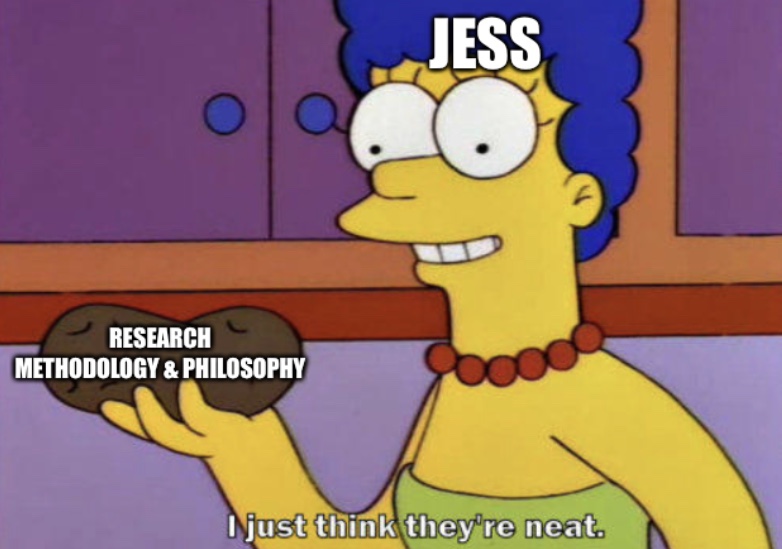
In formulating our capstone project, we’ve been asked to self-assess and analyze our ways of thinking when it comes to this stuff. See, there’s several schools of thought in music therapy research, but two stood out to me as polar opposites — positivism and constructivism. Positivism is essentially the belief that there is an absolute truth that can be measured, while constructivism tends to believe that many things can be true at once and often depends on a person’s lived experience. Neither of these ways of thinking are superior, but it helps to know which side of the coin you’re on before embarking in a research activity.
Most of my classmates leaned toward constructivism. Me? I was the weirdo positivist.
Maybe it’s because I come from an evangelical background that always preached that there was the way, the truth, and the life, and that was Jesus, and there was absolutely no other way to God, do not pass go, do not collect $200. Maybe it’s the fact that I’m autistic and tend to think more literally than a lot of people. I like facts, and proof, and facts that I can prove in some quantitative way.
Maybe there’s more than one answer to the big questions of the universe, but one thing has to be truer than everything else, right?
I really want to think I could play a song like the one above and everyone would have a universal and measurable experience. Like, the sound of a pretty piano piece increases serotonin in the brain by an average of 45 percent in all subjects of the study.
Unfortunately, serotonin is not the bodily fluid most associated with that piece.
You see, several years ago, a video went viral on ye olde interwebs. An absolutely putrid, disgusting video of two women enjoying each other’s…company. I’m not going to name it here, but if you haven’t gleaned what video it is by now, congratulations! You haven’t been corrupted by the internet!

Unfortunately (and probably to the chagrin of Mr. Roy), the piano piece you just heard was used as background music for the aforementioned shock video. So if you’re like me and had sadistic friends, you were probably tricked into watching this monstrosity. And chances are, you were traumatized.
You see, positivism doesn’t account for people’s unique experiences. If you’ve never heard the song in the context of that video, you’d probably have a very different reaction than someone who has. This is why learning to see things from other perspectives and accepting that there’s no one “correct” perspective is so important in music therapy. Music doesn’t exist in a vacuum. A song might evoke a positive emotion for you, but to someone else, that song was performed by their abuser’s favorite band. Or perhaps someone in that band was an abuser: I can’t listen to Brand New or All Time Low the same way anymore, which means half of the music I liked in high school is ruined forever. Thankfully I’ve still got Jimmy Eat World.

I never got why music therapy, especially certain listening experiences, were contraindicated for particular patients. Music evokes a lot of emotions, and they’re not always positive. That’s the danger of a strictly positivist philosophy. Emotion is not easy to quantify, and it’s even more difficult to predict.
My perspectives are changing all the time, and the older I get, the more I’m realizing that everyone has a different version of reality. Maybe humans are more complicated than can be described with numbers. Maybe I need to learn to be okay with that. I always sought solace in certainty, in knowing there was an answer. Perhaps no one can know the answers, because there are none. Or conversely, there’s a zillion correct answers.
I may never know for sure, and I need to accept that.
 JESSA JOYCE